Open Source
Anthropic Launches 33 Open Source Plugins
Lev Selectorhigh confidence
Why it matters
- →Open source plugins can accelerate development and integration for AI applications.
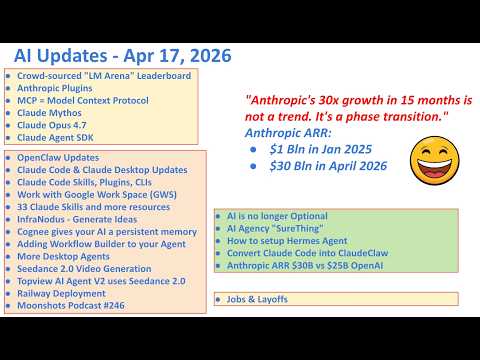
Anthropic has unveiled 33 open source plugins on GitHub, significantly enriching the Claude ecosystem. These plugins provide ready-made solutions for various tasks, including integration with Google Workspace and enhanced workflow capabilities. This move is expected to disrupt the SaaS market by offering users more versatile and accessible tools.
Read originalThe story around this
Earlier coverage that leads up to this article, and what followed. Lines connect each piece to the closest one after it, converging here.
How we got here
- 1Anthropic launches Cowork, a new AI agent
VentureBeat AI · January 12, 2026 · Related
- 2Claude Opus 4.6 Released
AI Explained · February 6, 2026 · Related
- 3Claude Expands Features for Enterprise Use
Lev Selector · March 27, 2026 · Related
- 4Anthropic accidentally leaks Claude's source code
Fireship · April 1, 2026 · Related
- 5Anthropic restricts OpenClaw access to Claude plans
The Rundown AI · April 6, 2026 · Related
- 6Anthropic Previews Claude Mythos AI System
The AI Advantage · April 8, 2026 · Related
- 7Claude Opus 4.7 Released by Anthropic
The AI Advantage · April 16, 2026 · Related
- 8Claude Opus 4.7 Released with New Benchmarks
AI Explained · April 17, 2026 · Related
What happened next
- 9Anthropic Launches Claude for Small Business
Anthropic · May 13, 2026 · Same story
- 10Anthropic releases Claude Opus 4.8
AI News · May 29, 2026 · Same story
- 11Anthropic Releases Open Source Tool for AI Agents
Duncan Rogoff · June 19, 2026 · Same story
- 12Anthropic Launches Claude Science for Research
MIT Technology Review AI · June 30, 2026 · Related
- 13Anthropic Launches In-App Browser for Claude Code
Matt Wolfe · July 29, 2026 · Same story
Follow this story
Open the full story →Anthropic Launches 33 Open Source Plugins
7 developments
- Apr 17 · Lev Selector
Anthropic Launches 33 Open Source Plugins (This article) - Apr 20 · The Rundown AI
Anthropic launches Claude Design for prototyping↳ Anthropic launches Claude Design to transform prompts and codebases into interactive prototypes using its Opus 4.7 vision model. - Apr 20 · Duncan Rogoff
Anthropic Releases Official Claude Code Learning Resources↳ Anthropic released an official GitHub repo with structured workflows and prompt guides for Claude Code. - Apr 21 · Fireship
Claude Design Launches with New Features - Apr 24 · Matt Wolfe
Claude Design and Live Artifacts Launched - Apr 28 · Anthropic
Anthropic Launches Claude Connectors for Creative Tools - Apr 28 · The Verge Creator Economy
Claude integrates with creative software tools
More in Open Source
 © Hugging Face Blog
Open Sourceagents
Tether AI launches BotPsy, a sub-billion agentic model
Tether AI Research has released BotPsy, an 0.8B-parameter model built on Qwen3.5 that specializes in tool-use and agentic workflows for on-device deployment. It achieves state-of-the-art performance in its size class, outperforming larger models like Qwen3.5-2B-Think on benchmarks such as BFCL v4 and ACEBench while maintaining strict privacy by keeping data local. The model is designed to handle routine tasks like calendar management and web search without relying on expensive cloud APIs, offering a viable path for private, self-hosted personal assistants. With open weights under Apache 2.0 and GGUF support, it provides immediate utility for developers building lightweight, autonomous agents.
Hugging Face Blog
 © Hugging Face Blog
Open Sourceother
NVIDIA releases 9M synthetic Japanese finance personas
NVIDIA has released a massive synthetic dataset of 9 million Japanese financial personas, addressing the privacy and data scarcity bottlenecks in localizing AI for Japan. By grounding these profiles in official government statistics rather than real customer records, it allows developers to train and red-team agents without violating strict privacy regulations. The inclusion of specific attributes like household assets and financial literacy provides a level of demographic granularity that generic Western-centric datasets simply cannot match. This effectively lowers the barrier for building culturally accurate, compliant AI systems in one of the world's largest economies.
Hugging Face Blog
 © Matt Wolfe
Open Sourceimage
Pruna Releases PH3 Image Open-Weight Model
Pruna has released PH3 Image, an open-weight image generation model available on Hugging Face with specific hardware requirements.
Matt Wolfe