Market & Regulation
Anthropic Revenue Grows 30x in 15 Months
Lev Selectorhigh confidence
Why it matters
- →This growth highlights the rapid evolution and competitive dynamics in the AI sector.
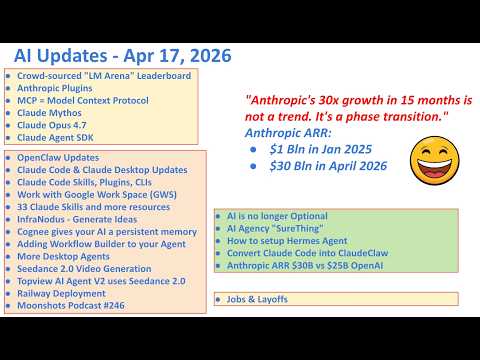
Anthropic has reported a staggering 30-fold growth in its annual recurring revenue over the past 15 months, reaching $30 billion. This growth trajectory has positioned Anthropic ahead of OpenAI, which currently stands at $25 billion. Industry analysts suggest that this shift represents a significant phase transition in the AI landscape, indicating a robust competitive edge for Anthropic.
Read originalThe story around this
Earlier coverage that leads up to this article, and what followed. Lines connect each piece to the closest one after it, converging here.
What happened next
- 1Anthropic Surpasses OpenAI in Business Customers
TechCrunch AI · May 13, 2026 · Same story
- 2Anthropic Overtakes OpenAI in Business Adoption
Lev Selector · May 15, 2026 · Same story
- 3Anthropic Projects First Profitable Quarter
TechCrunch AI · May 21, 2026 · Same story
- 4Anthropic Valuation Surpasses OpenAI
Matt Wolfe · July 1, 2026 · Same story
- 5OpenAI and Anthropic Report Significant ARR Growth
The AI Daily Brief · August 3, 2026 · Same story
More in Market & Regulation
 © TechCrunch AI
Market & Regulationbusiness
Nebius delays data centers, cuts revenue forecast
Nebius is facing the harsh reality of scaling AI infrastructure: even with $40 billion in planned spending and massive prepayments from Microsoft and Meta, physical construction delays are derailing timelines. A key New Jersey site is months behind schedule due to regulatory fines and generator issues, forcing a shift in delivery dates to 2027. This isn't just a logistical hiccup; it signals that the 'neocloud' model of financing builds with customer cash is fragile when third-party operators fail. The market reacted swiftly, dropping shares by 17% after Nebius cut its 2026 revenue forecast, proving that hype cannot override concrete capacity.
TechCrunch AI
 © MIT Technology Review AI
Market & Regulationother
Nvidia privately confirms chip tracking feasibility
Nvidia has privately assured lawmakers that it can technically implement geotracking for its AI chips, contradicting public industry claims that such measures are infeasible. This admission comes amid a smuggling scandal involving Jensen Huang and Megaspeed, pushing the US government toward mandatory location verification via the Chip Security Act. While current tools like Fleet Intelligence already monitor data center locations, this private confirmation suggests Nvidia possesses the underlying capability to enforce stricter export controls if mandated.
MIT Technology Review AI
 © TechCrunch AI
Market & Regulationagents
United Airlines blocks AI agents from booking flights
United Airlines is actively blocking third-party AI agents from accessing its booking systems, marking a significant shift in how legacy infrastructure handles autonomous software. The airline cites cybersecurity risks from shared credentials and potential violations of federal aviation rules requiring human check-ins. This move aligns with similar warnings from major banks like Bank of America, signaling that critical industries are drawing hard lines around where human oversight is legally required. It effectively kills the dream of fully autonomous travel booking for now, forcing a re-evaluation of agent integration in regulated sectors.
TechCrunch AI