Models & Labs
Google renames NotebookLM to Gemini Notebook
The Verge AIhigh confidence
Why it matters
- →The rebranding aligns the app with Google's broader AI strategy, enhancing integration with Gemini and Search.
- →New features like secure cloud computing for code execution expand the app's functionality for business users.
- →The app's evolution from Project Tailwind to Gemini Notebook reflects Google's ongoing investment in AI-driven productivity tools.

Google has rebranded its AI note-taking app from NotebookLM to Gemini Notebook, reflecting its integration with Google's AI ecosystem. Initially launched as Project Tailwind, the app has been enhanced with features like AI-generated content and now supports secure cloud computing for code execution. This feature is currently available to Google AI Ultra and Workspace business customers, with plans to expand to Pro users soon. The rebranding and new capabilities highlight Google's focus on advancing AI-powered productivity tools.
Read originalThe story around this
Earlier coverage that leads up to this article, and what followed. Lines connect each piece to the closest one after it, converging here.
How we got here
- 1Google unveils Gemini-powered Googlebooks and Android updates
TechCrunch AI · May 12, 2026 · Related
- 2Google Unveils Gemini Intelligence for Android Devices
The Rundown AI · May 13, 2026 · Related
- 3Google Introduces Gemini Intelligence for Android
Matt Wolfe · May 15, 2026 · Related
- 4Google Enhances Gemini App with New AI Features
TechCrunch AI · May 19, 2026 · Related
- 5Google Unveils Gemini 3.5 AI Model
Matt Wolfe · May 22, 2026 · Related
- 6Google Unveils Gemini Omni and Gemini 3.5 Models
Google AI Blog · May 29, 2026 · Related
- 7Google NotebookLM Upgrades to Gemini 3.5
The Verge AI · June 8, 2026 · Same story
- 8Google Launches Gemini Spark AI Agent
Skill Leap AI · June 11, 2026 · Related
What happened next
- 9Google Revamps Gemini AI Usage and Pricing
WIRED AI · July 18, 2026 · Background
- 10Google DeepMind Launches Gemini 3.5 Transcribe
Google DeepMind · August 26, 2026 · Background
- 11Google's Gemini Notebook Integrates with Google Play Books
The Verge AI · August 27, 2026 · Related
- 12Google's August AI Innovations: Gemini and Beyond
Google AI Blog · September 1, 2026 · Related
- 13Google Releases Gemini 3.8 Flash Model
Matthew Berman · September 3, 2026 · Background
More from The Verge AI
 © The Verge AI
Video & Creative AIvideo
Nikon disqualifies AI-generated microscopy winner
Nikon has stripped first place from its Small World in Motion contest after the winning entry was revealed to be generated by generative AI. Dr. Ning Xu admitted to using an unsupervised neural network for post-processing, a move that violated the competition's strict rules on authenticity. This incident forces Nikon to rewrite its evaluation procedures, highlighting the growing difficulty of distinguishing between optical enhancement and synthetic fabrication in scientific imaging. The disqualification serves as a stark warning to researchers about the boundaries of AI-assisted visualization.
The Verge AI
 © The Verge AI
Agentsagents
Instinct AI holds ground against OpenAI and Meta
Instinct’s quiet launch proves that a text-message-only interface can compete with the polished consumer agents from OpenAI and Meta. By bypassing dedicated apps for iMessage and WhatsApp, it achieves ubiquity on devices where users already live, turning conversation into action without friction. While big tech offers mascots and menus, Instinct relies on raw utility to handle life admin like booking appointments and processing returns. This approach suggests that simplicity and accessibility might outweigh feature bloat in the early agent market.
The Verge AI
 © The Verge AI
Coding Toolscoding
Anthropic launches free AI security scans for open-source
Anthropic is deploying its most powerful models, including Mythos, to automatically scan open-source repositories for vulnerabilities without human review. This move shifts the burden of code auditing onto AI, offering speed and scale that human teams cannot match, but it also risks flooding maintainers with false positives—a problem already straining projects like Linux. By making this service free, Anthropic is effectively subsidizing the security infrastructure of the open-source ecosystem while positioning its models as essential defensive tools. The real test is whether developers can trust automated triage over noisy alerts.
The Verge AI
More in Models & Labs
Models & Labsmodels
llama.cpp b11535 release with ROCm 10 and CUDA 13
This release quietly cements llama.cpp as the universal inference runtime by adding default support for ROCm 10.0 and CUDA 13.4 across Linux and Windows. AMD GPU users finally get parity with NVIDIA's latest driver stack without manual configuration, while Apple Silicon KleidiAI builds are temporarily disabled to resolve stability issues. The inclusion of Snapdragon NPU support on Linux signals a serious push into edge AI hardware beyond just x86 and ARM CPUs. It is less about new features and more about ensuring the toolchain keeps pace with the rapidly evolving GPU landscape.
llama.cpp Releases
Models & Labscoding
llama.cpp b11540 adds ROCm 10 and CUDA 13 support
This release quietly closes the hardware gap for local inference by adding default builds for ROCm 10.0 and CUDA 13.4 across Linux and Windows. AMD users finally get parity with NVIDIA in the binary distribution, while CUDA 13 support future-proofs setups on newer drivers. The inclusion of Snapdragon and OpenVINO binaries further broadens the hardware surface area without requiring custom compilation. It is a pragmatic update that makes llama.cpp the most accessible runtime for diverse local AI hardware.
llama.cpp Releases
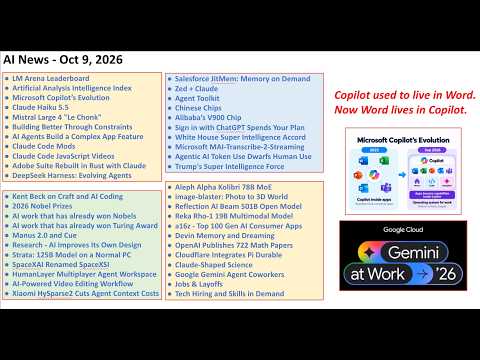 © Lev Selector
Models & Labsmodels
Mistral Large 4 and Claude Haiku 5.5 Released
Mistral releases Large 4 'Le Chonk' while Anthropic launches Claude Haiku 5.5, continuing the trend of cheaper, faster frontier models.
Lev Selector