Models & Labs
NVIDIA Unveils AI Storage Advancements at FMS
NVIDIA Bloghigh confidence
Why it matters
- →Open sourcing cuFile APIs allows for faster, more secure data access by GPUs.
- →The Storage-Next initiative aims to standardize and optimize AI storage solutions.
- →SCADA framework enhances AI performance by efficiently managing data access.
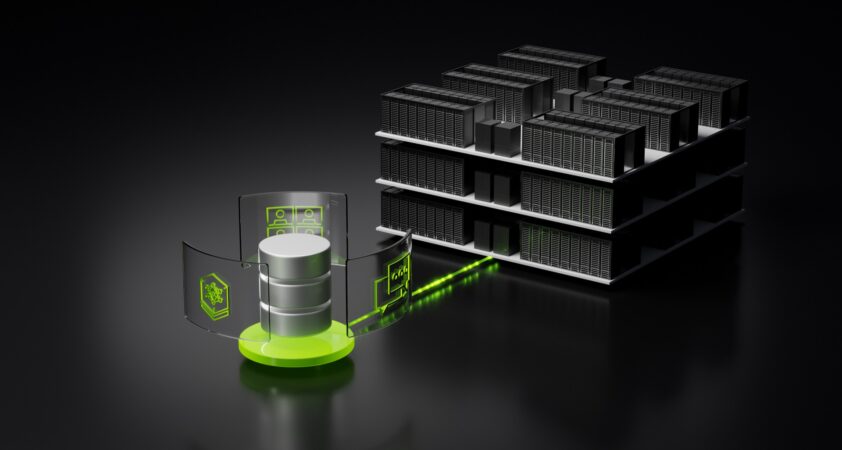
NVIDIA has announced significant advancements in AI storage at the Future of Memory and Storage conference. The company is open sourcing its cuFile APIs, allowing GPUs to directly access storage, which reduces data access times to microseconds. This initiative is part of a broader effort, including the Storage-Next initiative, to create a secure and efficient storage ecosystem for AI. NVIDIA's SCADA framework further optimizes data access by enabling GPUs to retrieve only the necessary data, enhancing AI performance. These developments aim to improve the productivity and efficiency of AI infrastructure.
Read originalThe story around this
Earlier coverage that leads up to this article, and what followed. Lines connect each piece to the closest one after it, converging here.
More in Models & Labs
Models & Labsmodels
llama.cpp b11535 release with ROCm 10 and CUDA 13
This release quietly cements llama.cpp as the universal inference runtime by adding default support for ROCm 10.0 and CUDA 13.4 across Linux and Windows. AMD GPU users finally get parity with NVIDIA's latest driver stack without manual configuration, while Apple Silicon KleidiAI builds are temporarily disabled to resolve stability issues. The inclusion of Snapdragon NPU support on Linux signals a serious push into edge AI hardware beyond just x86 and ARM CPUs. It is less about new features and more about ensuring the toolchain keeps pace with the rapidly evolving GPU landscape.
llama.cpp Releases
Models & Labscoding
llama.cpp b11540 adds ROCm 10 and CUDA 13 support
This release quietly closes the hardware gap for local inference by adding default builds for ROCm 10.0 and CUDA 13.4 across Linux and Windows. AMD users finally get parity with NVIDIA in the binary distribution, while CUDA 13 support future-proofs setups on newer drivers. The inclusion of Snapdragon and OpenVINO binaries further broadens the hardware surface area without requiring custom compilation. It is a pragmatic update that makes llama.cpp the most accessible runtime for diverse local AI hardware.