16 × AIAI signal, amplified
AI newsAboutSources
TelegramFollow on Telegram
AI newsAboutSources
16 × AIAI signal, amplified

An AI news engine that ingests trusted sources, scores with Claude, and posts only what clears the bar.

Follow on Telegram →

Subscribe

  • Telegram
  • RSS
  • All channels

Legal

  • Privacy
  • Imprint
© 2026 16 × AI. All rights reserved.Curated by Claude. Posts every 6 hours. No newsletter, no funnel.
Home/Models & Labs
Models & Labs

NVIDIA Unveils Factory Operations Blueprint for AI-Driven Factories

NVIDIA Blog·June 1, 2026·high confidence

Why it matters

  • →FOX enables real-time optimization of factory operations through AI.
  • →It allows for the integration of various factory systems into a cohesive decision-making framework.
  • →Early adopters report significant improvements in productivity and cost reduction.
NVIDIA Unveils Factory Operations Blueprint for AI-Driven Factories
©NVIDIA Blog

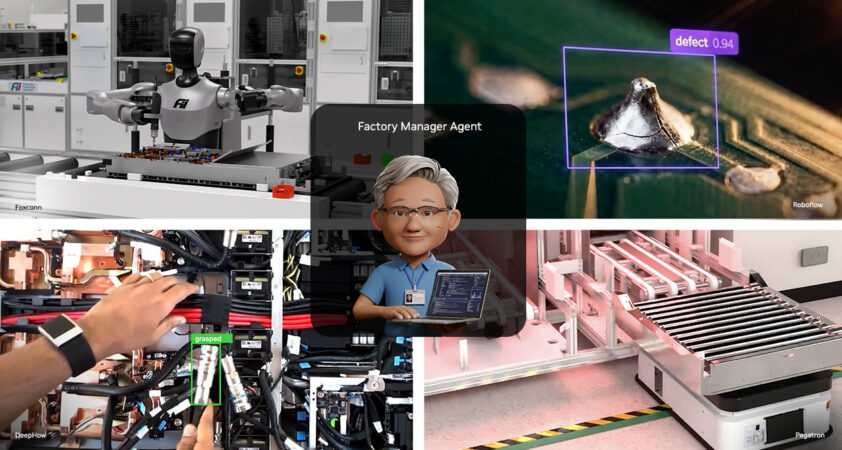
NVIDIA has introduced the Factory Operations Blueprint (FOX) at GTC Taipei, aiming to transform factory management with AI. FOX provides a framework for building autonomous agents that can manage and optimize factory operations in real-time. It leverages NVIDIA's DGX Station, equipped with a powerful superchip, to run large AI models locally. Early adopters like Foxconn and Pegatron are using FOX to enhance productivity and reduce operational costs. This development marks a significant step towards integrating AI into manufacturing, promising improved efficiency and reduced machine failures.

Read original

More from NVIDIA Blog

Financial Institutions Embrace Transaction Foundation Models© NVIDIA Blog
Market & Regulationbusiness

Financial Institutions Embrace Transaction Foundation Models

Financial institutions are increasingly adopting transaction foundation models to unify and enhance their AI capabilities. These models, powered by NVIDIA's technology, allow firms to interpret consumer behavior in context, improving tasks like fraud detection and credit scoring. By leveraging transformer architectures, these models transform raw transaction data into actionable intelligence, reducing the need for handcrafted features and enabling more efficient AI deployment. This shift marks a significant evolution in how financial data is processed, offering a more integrated and scalable approach to AI in the industry.

NVIDIA Blog·Jun 2, 2026
NVIDIA Jetson Advances Agentic AI in Robotics© NVIDIA Blog
Models & Labsmodels

NVIDIA Jetson Advances Agentic AI in Robotics

NVIDIA's latest JetPack 7.2 release marks a significant step in bringing agentic AI capabilities to the physical world, particularly in robotics and industrial automation. By integrating the NemoClaw framework, Jetson devices can now deploy AI agents that automate complex tasks, from defect detection to autonomous decision-making. This update enhances the Jetson platform with improved performance and memory optimization, making it more accessible for developers to create sophisticated AI systems. The move from server-based AI to edge deployment signifies a shift towards more autonomous and efficient operations across various industries.

NVIDIA Blog·Jun 2, 2026
NVIDIA Expands Global AI Cloud Ecosystem© NVIDIA Blog
Market & Regulationbusiness

NVIDIA Expands Global AI Cloud Ecosystem

NVIDIA is broadening its AI Cloud ecosystem to cater to the surging global need for AI computational resources. By collaborating with partners worldwide, NVIDIA aims to position AI factories closer to data sources and users, thereby improving the efficiency of AI training, inference, and deployment. This expansion includes new partnerships in regions such as Southeast Asia, Australia, and the Americas, focusing on scalable and energy-efficient infrastructure. The initiative strengthens NVIDIA's role in the AI infrastructure sector, supporting applications from enterprise AI to national AI initiatives, and ensuring that AI capabilities are more accessible and effective.

NVIDIA Blog·Jun 1, 2026

More in Models & Labs

Models & Labsmodels

llama.cpp adds EXAONE 4.5 implementations

The latest llama.cpp release expands its capabilities with the integration of EXAONE 4.5, bringing new vision markers and projector paths into the fold. This update aligns EXAONE 4.5 with the Qwen2.5-VL-style encode path, enhancing model loading and tensor registration processes. Developers will find improved performance and compatibility, particularly when working with EXAONE models. While no new models are introduced, the release refines existing functionalities, ensuring robust performance across various systems. This step forward is crucial for developers seeking to leverage EXAONE 4.5's full potential.

llama.cpp Releases·Jun 2, 2026
Models & Labsmodels

llama.cpp b9455 Release Adds Quantized KV Cache

The latest b9455 release of llama.cpp introduces quantized KV cache support, a notable enhancement for efficiency in AI model inference. This update also addresses a partial view fix and removes an overly strict assert, improving the overall robustness of the software. While the release includes various platform builds, the focus remains on optimizing performance across different environments. The addition of quantized KV cache support is a step forward in making AI models more resource-efficient, particularly beneficial for developers working with limited computational resources.

llama.cpp Releases·Jun 2, 2026
Models & Labsmodels

llama.cpp b9457 release focuses on Vulkan improvements

The latest b9457 release of llama.cpp brings a notable improvement in Vulkan performance by reducing host memory lock contention, which can enhance efficiency in certain workloads. This update replaces unique_lock with lock_guard, aiming to streamline operations. While the release doesn't introduce new models or major features, it continues to refine the platform's compatibility across various systems, including macOS, Linux, and Windows. The focus remains on optimizing existing capabilities rather than expanding into new territories.

llama.cpp Releases·Jun 2, 2026