Coding Tools
llama.cpp b11104 adds multi-addr server binding
llama.cpp Releaseshigh confidence
Why it matters
- →Enables flexible network routing for local LLM servers behind proxies.
- →Removes single-address constraint, simplifying complex deployment topologies.
- →Includes updated CUDA 13 and ROCm 10.0 binaries for broader hardware support.
llama.cpp has released version b11104, introducing support for binding the llama-server to multiple network addresses. This update allows users to expose the inference endpoint on various interfaces simultaneously, simplifying integration with reverse proxies and local development environments. The release also includes updated binaries supporting CUDA 13.4 and ROCm 10.0 across Linux and Windows platforms. Existing features like KleidiAI on Apple Silicon remain available but are not the primary focus of this specific patch.
Read originalMore from llama.cpp Releases
Coding Toolscoding
llama.cpp b11105 adds ROCm 10 and Snapdragon support
This release quietly cements llama.cpp as the universal inference runtime by finally bringing full ROCm 10.0 support to both Linux and Windows, closing a long-standing gap for AMD GPU users who previously had to rely on workarounds or older versions. The inclusion of CUDA 13 builds alongside CUDA 12 ensures compatibility with the latest NVIDIA driver stacks without forcing users into beta territory. Perhaps most notably, the addition of native Snapdragon support on Linux marks a significant step toward efficient AI inference on ARM-based mobile and edge devices, expanding the hardware ecosystem beyond traditional x86 and NVIDIA dominance.
llama.cpp Releases
Coding Toolscoding
llama.cpp b11108 adds ROCm 10 and Snapdragon support
This release quietly cements llama.cpp as the universal inference runtime by finally bringing ROCm 10.0 to both Linux and Windows builds. The real surprise is the inclusion of a setup guide for Linux arm64 on Snapdragon devices, bridging the gap between mobile silicon and local LLMs. CUDA 13 support is now standard across platforms, ensuring compatibility with the latest NVIDIA stacks. While KleidiAI on macOS is disabled in this specific build, the broader platform coverage means developers no longer need to compile from source for most hardware configurations.
llama.cpp Releases
Coding Toolscoding
llama.cpp b11109 fixes precision bugs
This release addresses a critical correctness issue in the MUL_MAT_ID operation across Metal, CUDA, and Vulkan backends. When source tensors used F32 precision, these accelerators incorrectly accepted operations that should have been rejected, potentially leading to silent numerical errors or crashes. By gating this behavior behind ggml_prec checks, the update ensures strict adherence to supported precision levels on hardware like Apple Silicon and NVIDIA GPUs. This is a necessary stability patch for developers relying on mixed-precision inference workflows.
llama.cpp Releases
More in Coding Tools
Coding Toolscoding
Claude Code v2.1.280 adds Opus 5.5 and fixes agent stability
Claude Code just got its first major model upgrade with Opus 5.5 as the new default, bringing a 1M context window and aggressive pricing that reshapes local inference economics. Beyond the headline model swap, this release quietly stabilizes the background subagent system, fixing critical issues where tool lists were rebuilt instead of cached and reports were silently lost during compaction. The UI layer also sees significant polish, with mouse support in fullscreen mode and fixes for Windows terminal rendering that had plagued power users. This is less about new features and more about making the agent runtime reliable enough for heavy, multi-step workflows.
Claude Code Releases
 © GitHub Changelog
Coding Toolscoding
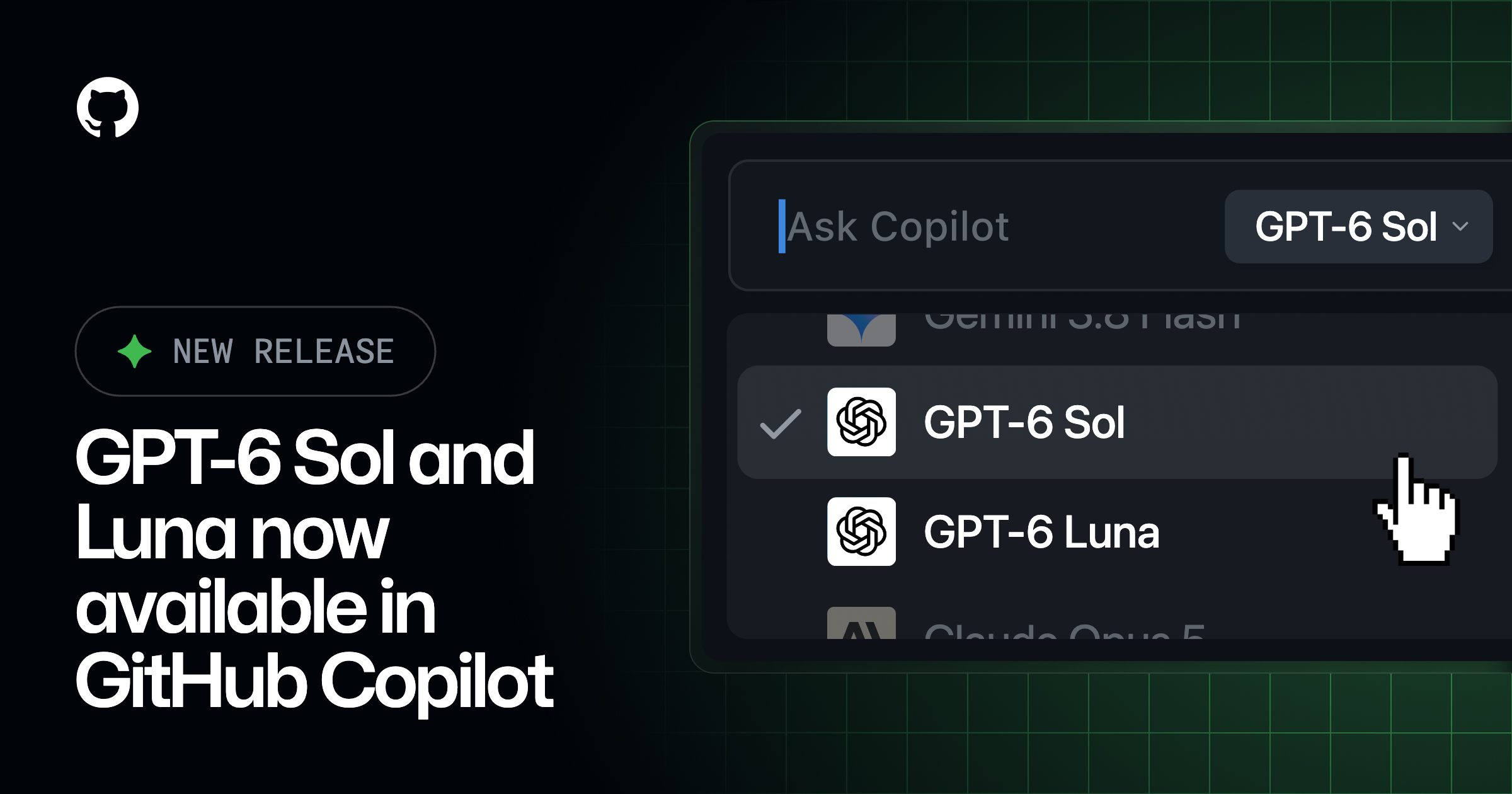
OpenAI expands GPT-6 family with Sol and Luna for Copilot
OpenAI is widening the GPT-6 lineup inside GitHub Copilot by adding two distinct models: Sol for complex agentic coding and Luna for fast, cheap tasks. This moves Copilot away from a single default toward a tiered strategy where developers can explicitly choose between heavy reasoning and lightweight efficiency. Sol targets multistep validation in Pro+ and Enterprise tiers, while Luna opens up to the broader Pro user base as the lowest-cost option. The gradual rollout across IDEs like VS Code and JetBrains means teams can now tune their coding assistants for specific workload profiles rather than accepting a one-size-fits-all approach.
GitHub Changelog
 © GitHub Changelog
Coding Toolscoding
GitHub Deprecates All-Platform CodeQL Bundle
GitHub is killing the convenience of a single download for CodeQL CLI. Starting with version 2.27.0, the monolithic all-platform bundle is deprecated and will vanish by March 2027. Users must now switch to platform-specific archives, a move that forces CI/CD pipelines to manage separate artifacts for Linux ARM64, x86_64, and macOS. This ends the era of 'one size fits all' distribution for static analysis tooling on GitHub, requiring developers to explicitly target their build environment's architecture.
GitHub Changelog