Models & Labs
NVIDIA AI Software Boosts Scientific Discovery
NVIDIA Bloghigh confidence
Why it matters
- →NVIDIA's software dramatically speeds up data processing, enabling faster scientific insights.
- →The tools support real-time analysis, crucial for handling large datasets in fields like astronomy.
- →This advancement could lead to quicker breakthroughs in understanding complex scientific phenomena.
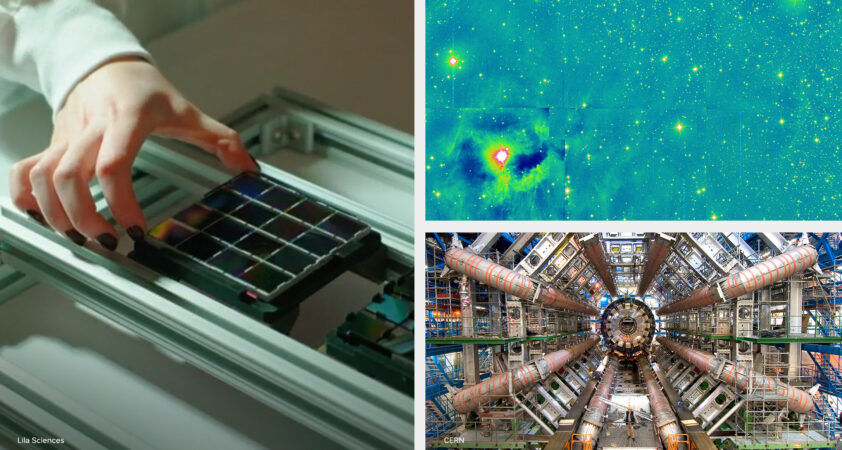
NVIDIA has unveiled new AI software at the ISC conference, designed to accelerate scientific research across various fields. The software includes the DAQIRI library and cuPhoton reference code, which enable real-time data processing on GPUs, significantly speeding up tasks that previously took much longer on CPUs. Notably, cuPhoton has achieved a 14,900x speedup in processing astronomical data from the Rubin Observatory. This advancement allows scientists to analyze large datasets more efficiently, paving the way for faster discoveries in areas like dark matter research and materials science.
Read originalMore from NVIDIA Blog

More in Models & Labs
Models & Labsmodels
llama.cpp b10955 release addresses heap corruption
The latest release of llama.cpp, b10955, tackles a critical issue of heap corruption by disabling the ggml-cpu precompiled header and fixing CACHE_LINE_SIZE ambiguity. This update ensures consistent CACHE_LINE_SIZE values across C++ kernels and C work-buffer sizing code, preventing heap-buffer-overflow and subsequent crashes. By restoring the natural include order and removing the std::hardware_destructive_interference_size branch, the update makes the value deterministic and include-order independent. This release is a technical fix that stabilizes the runtime environment for developers using llama.cpp.
llama.cpp Releases
Models & Labsmodels
llama.cpp b10956 release enhances SYCL backend
The latest llama.cpp release, b10956, introduces significant improvements to the SYCL backend, particularly for handling large k values in TOP_K operations. By implementing a radix select method, the update allows for efficient GPU-resident processing, avoiding previous limitations that forced operations to fall back to the CPU. This change enhances performance, especially in scenarios requiring large k values, such as qwen4exp's sparse-attention indexer. The update ensures that operations are more efficient and scalable, providing a notable boost in processing speed without regressing any measured shapes.
llama.cpp Releases
Models & Labsmodels
llama.cpp b10970 Release Expands Platform Support
The b10970 release of llama.cpp enhances its reach by incorporating fp32 accumulators in fattn-mma on CDNA devices, boosting performance on specific hardware. This update extends compatibility across macOS, Linux, Windows, and openEuler, with particular attention to CUDA and ROCm libraries. Although there are no new models introduced, the release reinforces llama.cpp's role as a flexible inference runtime, accommodating a wide array of hardware setups. Developers can now enjoy improved performance and broader deployment options, making it easier to integrate AI models into different environments.
llama.cpp Releases