16 × AIAI signal, amplified
AI newsAboutSources
TelegramFollow on Telegram
AI newsAboutSources
16 × AIAI signal, amplified

An AI news engine that ingests trusted sources, scores with Claude, and posts only what clears the bar.

Follow on Telegram →

Subscribe

  • Telegram
  • RSS
  • All channels

Legal

  • Privacy
  • Imprint
© 2026 16 × AI. All rights reserved.Curated by Claude. Posts every 6 hours. No newsletter, no funnel.
Home/Models & Labs
Models & Labs

NVIDIA Highlights Performance per Watt for AI Efficiency

NVIDIA Blog·July 14, 2026·high confidence

Why it matters

  • →Performance per watt is crucial for maximizing AI infrastructure efficiency in power-constrained environments.
  • →NVIDIA's Blackwell NVL72 platform offers significant improvements, enhancing token throughput and profitability.
  • →Extreme codesign across components optimizes AI inference workloads, crucial for scaling AI models.
NVIDIA Highlights Performance per Watt for AI Efficiency
©NVIDIA Blog

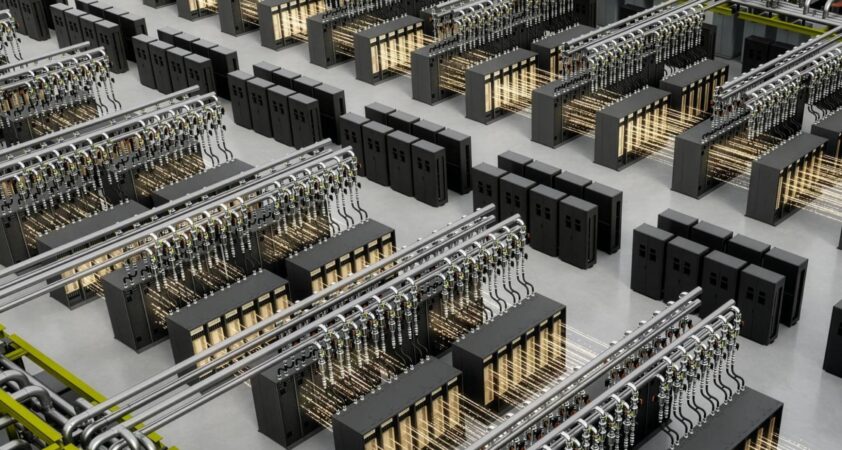
NVIDIA is focusing on performance per watt as a key metric for AI infrastructure efficiency, crucial for maximizing token throughput and profitability in power-constrained environments. Their Blackwell NVL72 platform offers up to 25x performance per watt improvement over previous generations, thanks to a comprehensive codesign approach. This involves integrating components from silicon to software to optimize AI inference workloads. The platform's efficiency is vital for scaling AI models and maintaining economic viability, making it a preferred choice for leading AI labs and service providers.

Read original

More from NVIDIA Blog

NVIDIA Nemotron Labs Empowers AI Customization© NVIDIA Blog
Models & Labsmodels

NVIDIA Nemotron Labs Empowers AI Customization

NVIDIA's Nemotron Labs is making waves by offering open models that allow enterprises to fully customize and control their AI systems. This approach enables businesses to tailor AI to their specific needs, ensuring accuracy and trustworthiness, especially in sensitive sectors like healthcare and legal. By leveraging open models, companies can inspect and improve AI performance without relying on third-party data handling. This shift from AI adoption to AI ownership is significant, as it allows for more efficient and cost-effective AI solutions, fostering innovation and experimentation across industries.

NVIDIA Blog·Jul 14, 2026

More in Models & Labs

Models & Labsmodels

llama.cpp b10002 Release Expands Platform Support

The b10002 release of llama.cpp enhances its functionality by adding new functions to check the contiguity of inner tensor dimensions, which is crucial for developers dealing with complex data structures. This update significantly broadens the range of supported platforms, including macOS, Linux, Windows, and openEuler. Noteworthy improvements include the integration of ROCm 7.2 for Ubuntu and CUDA 13 for Windows, which cater to specific hardware needs. Although some configurations like KleidiAI on Apple Silicon remain disabled, the release marks a step forward in creating a more adaptable AI development environment. Developers can now optimize performance across a wider array of hardware setups, making the tool more versatile and efficient.

llama.cpp Releases·Jul 15, 2026
Models & Labsmodels

llama.cpp b10004 release enhances f16 support

The b10004 release of llama.cpp significantly upgrades its Vulkan and CPU backends by fully integrating f16 SET_ROWS, bringing it on par with f32 capabilities. This update includes comprehensive backend tests and addresses Intel platform issues by implementing DenormPreserve 16. While no new models are introduced, the release broadens compatibility across platforms like macOS, Linux, Windows, and Android, enhancing its utility for developers. With ROCm 7.2 and CUDA 12 and 13 support, llama.cpp continues to evolve as a versatile inference runtime, accommodating a wide range of hardware configurations.

llama.cpp Releases·Jul 15, 2026
Models & Labsmodels

llama.cpp b10010 release adds CORS options

The latest llama.cpp release, version b10010, enhances server capabilities with new Cross-Origin Resource Sharing (CORS) options, allowing developers to fine-tune web application interactions. This update introduces a unique 'localhost' setting and includes rigorous testing to ensure stability. While the release doesn't feature new model architectures, it significantly broadens compatibility across macOS, Linux, Windows, and openEuler platforms. By focusing on server-side improvements, llama.cpp becomes more adaptable for developers integrating AI into web services, offering greater flexibility in deployment environments.

llama.cpp Releases·Jul 15, 2026