Market & Regulation
Wistron Opens AI Manufacturing Plant in Texas
NVIDIA Bloghigh confidence
Why it matters
- →The facility strengthens U.S. manufacturing capabilities for AI systems.
- →It represents a significant investment in domestic job creation and technology infrastructure.
- →The use of digital twins for plant design highlights innovative approaches in manufacturing.
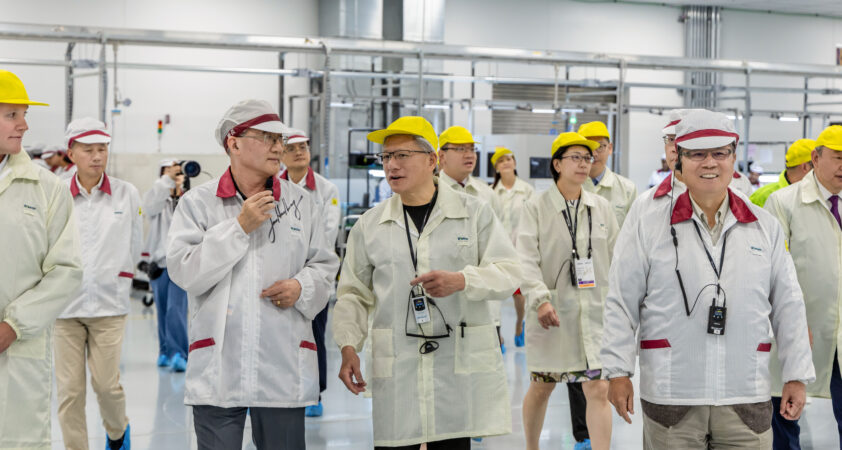
Wistron has opened a new 324,000-square-foot manufacturing plant in Fort Worth, Texas, to produce NVIDIA's advanced AI systems. The facility represents a $700 million investment and has already created over 500 jobs, with plans to expand to 1,000 by year-end. It will manufacture NVIDIA's GB300 Grace Blackwell Ultra Superchip and Vera Rubin Superchip, essential for AI infrastructure. The plant was designed using a digital twin, allowing for virtual optimization of production processes. This initiative is part of NVIDIA's broader strategy to enhance U.S. manufacturing and supply chains in the AI sector.
Read originalMore from NVIDIA Blog
 © NVIDIA Blog
Models & Labsmodels
NVIDIA AI Supercomputer Deployed at Naval School
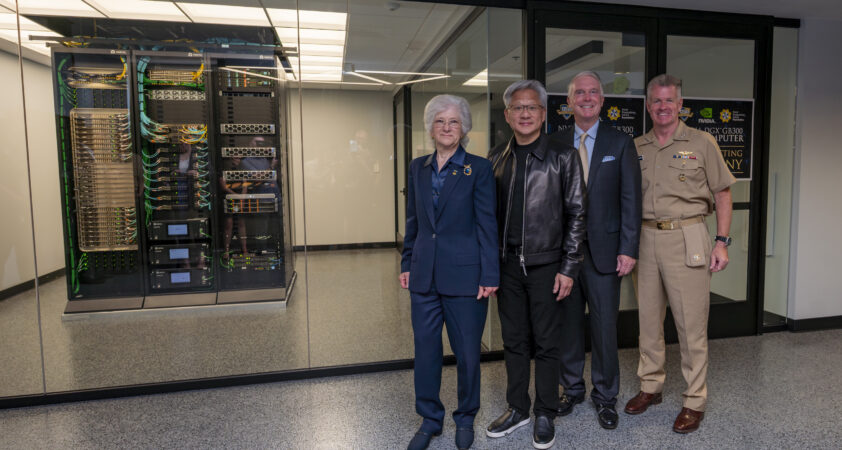
NVIDIA has commissioned its DGX GB300 supercomputer at the Naval Postgraduate School, marking a significant step in integrating advanced AI capabilities into military education. This powerful AI platform will enable students and faculty to engage in large-scale AI computing, enhancing research in areas like weather prediction and cybersecurity. The collaboration aims to modernize military education by providing hands-on experience with cutting-edge AI tools. This deployment not only enriches academic programs but also prepares military leaders to leverage AI in real-world scenarios.
NVIDIA Blog
 © NVIDIA Blog
Models & Labsmodels
NVIDIA Open Sources Medical Physics Simulation Framework
NVIDIA has unveiled an open-source, GPU-accelerated Medical Physics Simulation framework, a significant addition to its Isaac for Healthcare platform. This framework allows developers to simulate complex anatomy-device interactions, providing a virtual training ground for medical robotics. By enabling the creation of reusable simulation environments, it reduces the time and resources needed for hardware testing. The open-source nature ensures transparency and adaptability, crucial for regulatory compliance and innovation in healthcare robotics. This development could accelerate the deployment of advanced medical robots by providing a scalable and efficient simulation infrastructure.
NVIDIA Blog
 © NVIDIA Blog
Models & Labsmodels
NVIDIA Vera Rubin Boosts AI Efficiency and Scalability
NVIDIA's Vera Rubin platform is setting a new standard for AI infrastructure with its gigascale capabilities and impressive performance metrics. By integrating seven chips into a single system, it offers 10x more throughput per megawatt compared to previous models, making it a game-changer for power-constrained AI factories. The platform's advanced networking and cooling solutions further enhance its efficiency, reducing setup time and water usage significantly. This development not only supports Europe's AI ambitions but also provides a robust foundation for scalable, efficient AI operations worldwide.
NVIDIA Blog
More in Market & Regulation
 © TechCrunch AI
Investment · $40M
Market & Regulationbusiness
ServiceNow invests $40M in Indian banking software firm
ServiceNow's $40 million investment in BusinessNext marks a strategic move to bolster its presence in the financial services sector. By acquiring a 5% stake in the Indian banking software specialist, ServiceNow aims to leverage BusinessNext's expertise in AI-driven banking workflows. This partnership is set to enhance ServiceNow's global reach, particularly in markets where BusinessNext has limited presence. The collaboration combines ServiceNow's workflow automation capabilities with BusinessNext's customer-facing banking solutions, positioning both companies to capitalize on the shift towards AI-led operations in financial services.
TechCrunch AI
 © TechCrunch AI
Market & Regulationbusiness
Google's AI Spending Justified by Cloud Revenue Surge
Google's latest earnings report reveals a substantial increase in its cloud business, largely fueled by enterprise AI adoption. Google Cloud revenue jumped 82% year-over-year, reaching $24.8 billion, exceeding Wall Street's expectations. This growth reflects the transformative impact of Google's AI investments, which are reshaping its business operations. With a backlog of $514 billion in cloud contracts, Google's strategic emphasis on AI infrastructure is proving effective, despite significant capital expenditures. The company's AI chatbot, Gemini, also shows robust user growth, indicating widespread AI integration across its services.
TechCrunch AI
 © WIRED AI
Market & Regulationbusiness
White House Debates Response to Chinese AI Advances
The White House is facing a complex challenge in addressing China's rapid AI advancements, particularly after the release of the Kimi K3 model by China's Moonshot AI lab, which competes with leading US models. The administration is split, with some officials pushing for tighter controls on Chinese AI development, while others argue these measures may not be feasible. The urgency of the situation has increased following claims of a significant distillation attack by Alibaba on Anthropic's models. The White House is exploring potential actions to limit such practices, although an executive order is not anticipated in the near future. This situation highlights the competitive tension between US and Chinese AI capabilities and the difficulties in regulating AI technology on a global scale.
WIRED AI