Coding Tools
GitHub Copilot Code Review expands to all plans
GitHub Changeloghigh confidence
Why it matters
- →Code review automation is no longer a premium feature but a standard offering for all GitHub users.
- →Enterprise admins gain centralized control over AI review effort levels across their entire organization.
- →Granular triggers for drafts and new pushes allow developers to fine-tune when AI intervenes in the workflow.
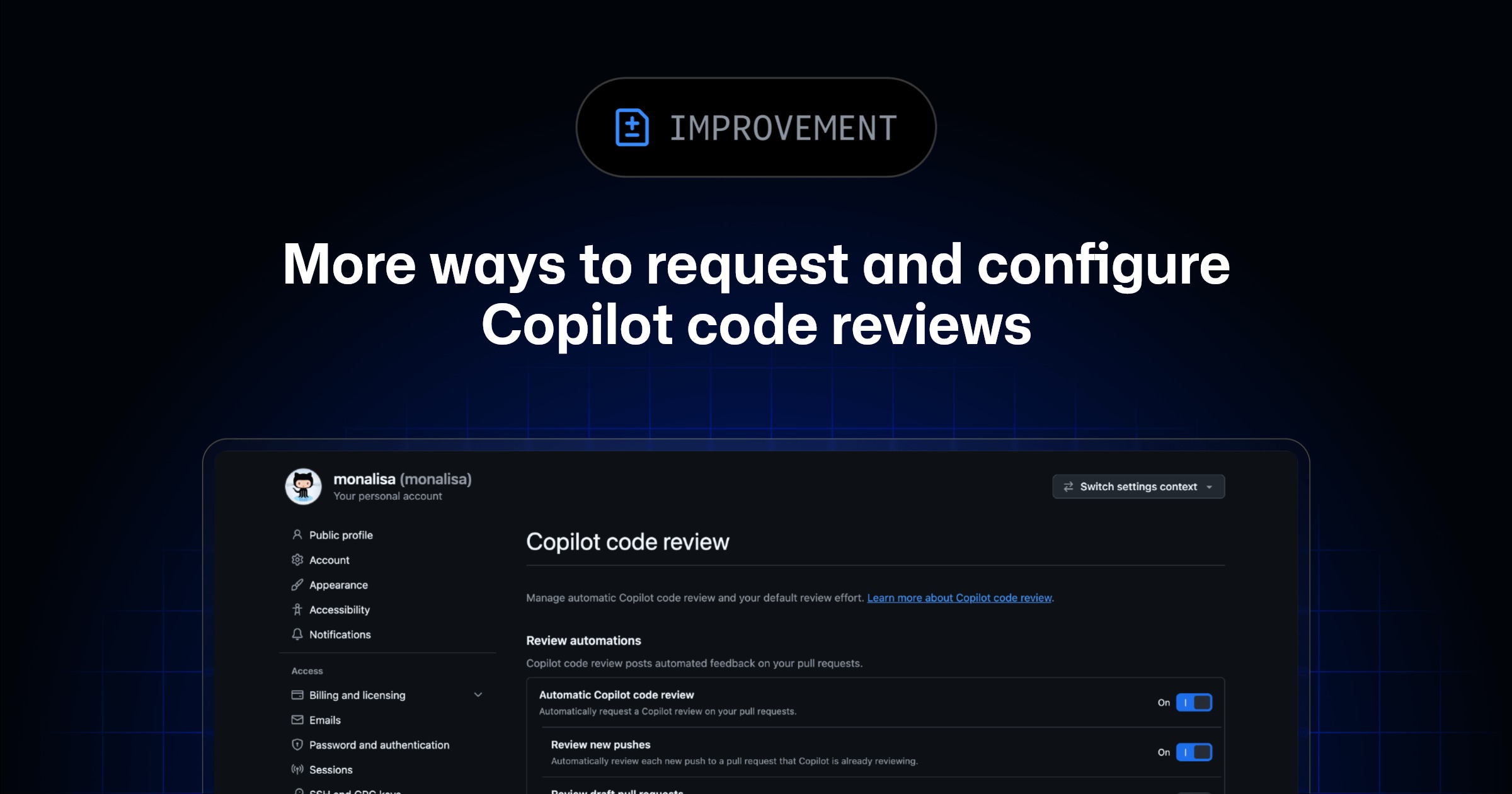
GitHub has made Copilot Code Review settings generally available across all subscription tiers, including Copilot Business and Enterprise. The update introduces a dedicated personal settings page for managing automatic reviews on pull requests, drafts, and new pushes, alongside configurable effort levels like Lite or Balanced. For enterprise administrators, the release adds organization-wide default review effort settings that inherit to repositories unless overridden. Previously restricted to Pro, Pro+, and Max users, these controls are now accessible to all Copilot subscribers.
Read originalMore from GitHub Changelog
 © GitHub Changelog
Coding Toolscoding
GitHub Actions drops Node 20, mandates Node 24
GitHub has permanently removed Node 20 from its hosted runners, forcing all JavaScript actions to run on Node 24. The safety net of the unsecure node opt-out is gone, meaning workflows relying on older action versions will break immediately. This shift eliminates legacy runtime support and introduces compatibility constraints for macOS 13.4 and ARM32 architectures. Maintainers must update their action metadata now, while workflow users need to upgrade dependencies to avoid CI failures.
GitHub Changelog
 © GitHub Changelog
Coding Toolscoding
GitHub Copilot adds local sandboxing
GitHub Copilot is finally addressing the security risks of AI agents running on your machine with a new local sandboxing feature. By default off, this preview allows developers to strictly limit what the AI can read, write, or access over the network for specific projects. It enforces these policies at the OS level, failing safely if restrictions cannot be applied rather than silently ignoring them. This shifts Copilot from a trust-based assistant to a tool with explicit, configurable boundaries, reducing the blast radius of accidental commands.
GitHub Changelog
 © GitHub Changelog
Coding Toolscoding
GitHub Copilot adds OpenTelemetry for enterprise agent monitoring
GitHub Copilot finally gives enterprises visibility into their AI agents with native OpenTelemetry support. Administrators can now route agent traces to existing monitoring tools, tracking model requests and tool usage without forcing developers to configure telemetry individually. This closes a critical gap in observability, allowing teams to investigate unexpected behavior through step-by-step execution flows. Prompt content remains excluded by default, balancing transparency with privacy concerns for sensitive code.
GitHub Changelog
More in Coding Tools
Coding Toolscoding
Claude Code v2.1.281 fixes session stability and adds Bedrock guardrails
This release stabilizes Claude Code's core reliability by fixing persistent bugs in session resumption and prompt caching that previously caused data loss or infinite loops. It also tightens enterprise security with new Bedrock upstream support for IAM role assumption and mandatory guardrail application. The update addresses critical edge cases like proxy stream drops and oversized tool calls, ensuring smoother operation in complex development environments.
Claude Code Releases
Coding Toolscoding
llama.cpp b11140 optimizes sparse attention on CUDA
This release targets a specific bottleneck in long-context inference by optimizing the sparse flash attention prefill step for NVIDIA GPUs. By templating kernels to unroll loops at compile time, batched sparse operations drop from 586 microseconds to 244 microseconds on 49k context windows. This isn't just a generic speed bump; it makes handling very long documents significantly more efficient for users relying on sparse attention mechanisms. The change is already baked into the standard CUDA builds, requiring no special flags.
llama.cpp Releases
Coding Toolscoding
llama.cpp b11146 adds CUDA 13 and Snapdragon support
The latest llama.cpp build brings immediate relevance to users on bleeding-edge NVIDIA hardware with native CUDA 13.4 support across Linux and Windows, closing the gap for those testing next-gen GPU architectures. More notably, it finally addresses the mobile inference landscape by including a dedicated build for Linux arm64 Snapdragon devices, covering CPU, Adreno GPU, and Hexagon NPU paths. This moves local AI beyond just desktop GPUs into the realm of high-performance edge computing on Qualcomm silicon. While Apple Silicon builds have KleidiAI disabled in this specific release, the expansion to ARM-based mobile NPUs marks a significant shift in where llama.cpp can run efficiently.
llama.cpp Releases