Models & Labs
llama.cpp b10156 Release Expands Platform Support
llama.cpp Releaseshigh confidence
Why it matters
- →ROCm 7.2 support enhances performance for AMD GPU users.
- →Vulkan support increases flexibility across platforms.
- →The update strengthens llama.cpp's role as a versatile inference tool.
The b10156 release of llama.cpp has been announced, featuring expanded support for various platforms. Notably, ROCm 7.2 is now supported on Ubuntu x64, providing better integration for AMD GPU users. The release also includes Vulkan support for both Ubuntu and Windows, enhancing the software's flexibility. This update does not introduce new models but focuses on improving compatibility and performance across different hardware setups.
Read originalMore from llama.cpp Releases
Open Sourcemodels
llama.cpp b10158 Release Expands Platform Support
The latest b10158 release of llama.cpp continues its trend of broadening platform compatibility, though without major new features. Notably, the release includes support for ROCm 7.2 on Ubuntu x64, which is significant for AMD GPU users seeking alternatives to NVIDIA's CUDA. While KleidiAI support for Apple Silicon remains disabled, the release still covers a wide array of platforms, including Windows and openEuler. This update demonstrates llama.cpp's commitment to being a versatile inference runtime across diverse hardware configurations.
llama.cpp Releases
Open Sourcemodels
llama.cpp b10159 release enhances Metal backend
The latest b10159 release of llama.cpp introduces a new FWHT kernel for the Metal backend, significantly boosting performance for Apple Silicon users. This update, co-authored by YiChen Lv and Georgi Gerganov, also resolves a narrowing issue and refines formatting and style. Although the KleidiAI feature for macOS Apple Silicon is still disabled, the release maintains compatibility with platforms like Ubuntu, Windows, and openEuler. With ROCm 7.2 and CUDA 12 and 13 support, llama.cpp continues to evolve as a robust inference runtime, catering to diverse hardware configurations.
llama.cpp Releases
Models & Labsmodels
Llama.cpp b10164 Release Enhances CUDA Performance
The latest b10164 release of llama.cpp focuses on improving CUDA performance, particularly for Mamba-2 prefill acceleration. By introducing chunked SSD matrix multiplication, the update aims to enhance efficiency and memory coalescing. This release also addresses several technical fixes, including resolving a read-write race condition in CUDA operations. While there are no groundbreaking new features, these optimizations make llama.cpp a more robust choice for developers working with CUDA and related technologies.
llama.cpp Releases
More in Models & Labs
 © Together AI Blog
Models & Labsmodels
Together AI Enhances Model Inference Configuration
Together AI has introduced a sophisticated architecture for model inference that integrates endpoints, deployments, and configurations with capacity-aware traffic splitting. This system allows for seamless rollouts, A/B testing, and zero-downtime updates, making it easier for developers to manage and optimize AI models. By using immutable configurations and a weight-based traffic split, the platform ensures efficient resource allocation and scaling. This development simplifies the deployment process and enhances the reliability of AI applications by ensuring consistent performance and easy rollback options.
Together AI Blog
 © GitHub Changelog
Models & Labscoding
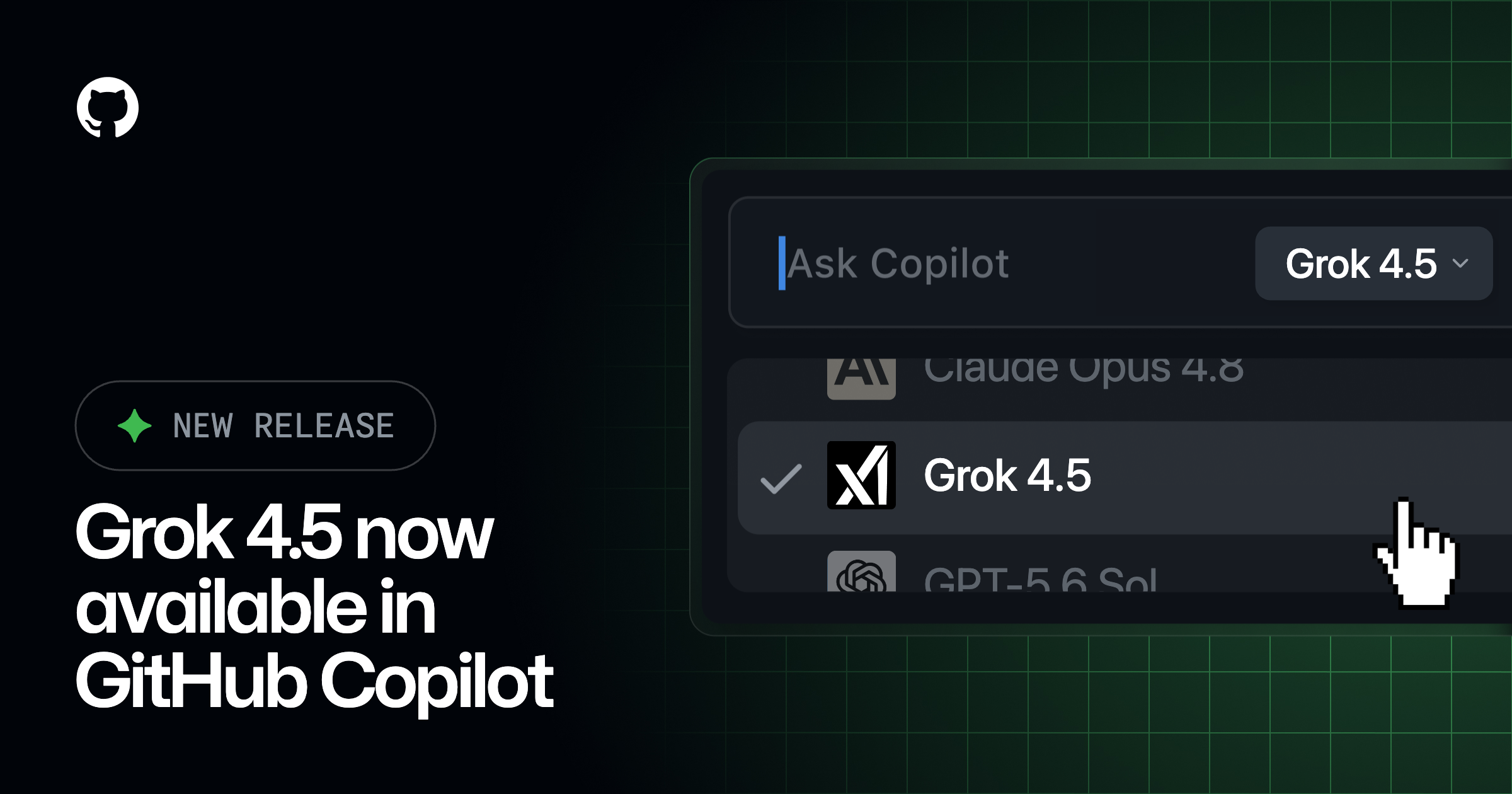
Grok 4.5 Now Integrated with GitHub Copilot
Grok 4.5, xAI's latest reasoning model, is now integrated into GitHub Copilot, enhancing its capabilities for complex coding tasks. With a massive context window of up to 500,000 tokens and support for both text and image inputs, Grok 4.5 is designed for fast, agentic coding and multi-step workflows. It excels in terminal-based coding tasks, particularly in Visual Studio Code and Copilot CLI, making it ideal for time-sensitive and complex coding challenges. This integration marks a significant step in improving the efficiency and capability of GitHub Copilot for developers.
GitHub Changelog
 © Hugging Face Blog
Models & Labsmodels
OlmoEarth Platform Enables Large-Scale Geospatial Inference
The OlmoEarth Platform is a significant advancement in geospatial inference, designed to handle the massive scale of Earth observation data. By processing terabytes of satellite imagery efficiently, it enables organizations to generate continent-scale maps in a day, at minimal cost. This platform addresses the challenges of data acquisition, processing, and inference, making it accessible even to organizations without extensive engineering resources. With its ability to run large-scale inference jobs using thousands of CPUs and GPUs, OlmoEarth is poised to transform how environmental data is utilized for applications like wildfire risk mapping and deforestation monitoring.
Hugging Face Blog