Models & Labs
Kimi K3 Open Weight Model Faces Scrutiny
Cole Medinhigh confidence
Why it matters
- →Highlights the limitations of public benchmarks in evaluating AI models.
- →Emphasizes the importance of real-world testing for AI reliability.
- →Encourages developers to adopt mixed-model workflows for efficiency.
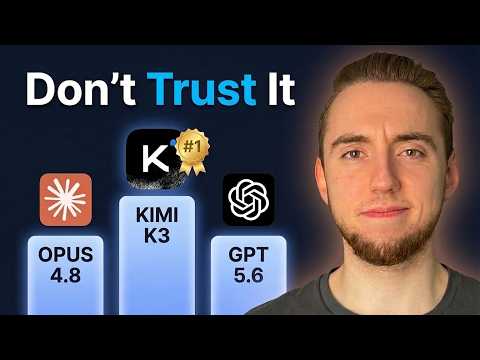
Kimi K3, an open weight model, is being critically evaluated despite claims of its superiority over models like Opus 4.8. Cole Medin's analysis reveals that while Kimi K3 can outperform in certain outputs, it suffers from reliability issues not captured by public benchmarks. The video provides a guide to building more realistic benchmarks, offering developers a clearer picture of the model's capabilities in real-world scenarios. This scrutiny highlights the need for mixed-model workflows to balance performance and cost.
Read originalThe story around this
Earlier coverage that leads up to this article, and what followed. Lines connect each piece to the closest one after it, converging here.
More in Models & Labs
Models & Labsother
llama.cpp b11193 adds Snapdragon Hexagon and ROCm 10
This release quietly expands llama.cpp's hardware support to include Qualcomm's Hexagon NPU on Linux arm64, a significant step for local inference on Snapdragon devices. It also updates CUDA builds to version 13.4 and introduces ROCm 10.0 binaries, keeping the project aligned with the latest NVIDIA and AMD driver ecosystems. KleidiAI on Apple Silicon is temporarily disabled in this build, likely due to stability checks rather than a feature rollback. For developers targeting edge AI or diverse GPU stacks, this update ensures broader compatibility without requiring custom compilation.
llama.cpp Releases
 © Lev Selector
Models & Labsmodels
NVIDIA NVFP4 and SoL-Pi Token Efficiency
NVIDIA introduced the NVFP4 4-bit format and SoL-Pi technology, which uses 2x fewer tokens for improved efficiency.