Models & Labs
llama.cpp b11563 release with CUDA 13 and ROCm 10
llama.cpp Releaseshigh confidence
Why it matters
- →CUDA 13 support allows users to leverage newer NVIDIA driver features and potential performance gains.
- →ROCm 10.0 integration improves AMD GPU compatibility for local inference workloads.
- →Hidden symbol visibility reduces API pollution for developers embedding llama.cpp in their applications.
llama.cpp has released version b11563, adding support for CUDA 13.4 and ROCm 10.0 binaries across Linux and Windows platforms. The update also changes default symbol visibility to hidden, preventing internal GGML symbols from leaking via the public API. Notably, KleidiAI builds for Apple Silicon are currently disabled in this release. The package continues to support a wide range of hardware including Vulkan, OpenVINO, and various CPU architectures.
Read originalThe story around this
Earlier coverage that leads up to this article, and what followed. Lines connect each piece to the closest one after it, converging here.
How we got here
- 1llama.cpp b11222 release with ROCm 10 and CUDA 13
llama.cpp Releases · September 28, 2026 · Same story
- 2llama.cpp b11274 release with CUDA 13 and ROCm 10
llama.cpp Releases · September 30, 2026 · Same story
More from llama.cpp Releases
Coding Toolscoding
llama.cpp b11555 adds ROCm 10 and Snapdragon support
This release quietly cements llama.cpp as the universal inference runtime by finally bringing first-class ROCm 10.0 support to both Linux and Windows. AMD GPU users no longer need workarounds, effectively closing a long-standing parity gap with NVIDIA's CUDA ecosystem. The inclusion of Snapdragon AI stack binaries for Linux marks a significant expansion into mobile-edge hardware, while the addition of CUDA 13 builds future-proofs the tool against upcoming driver requirements. By standardizing these complex backend integrations into single downloadable binaries, the project removes friction for anyone deploying local models on non-NVIDIA silicon.
llama.cpp Releases
Models & Labsmodels
llama.cpp adds Prism Bonsai 2 27B support
Prism's Bonsai 2 27B model is now natively supported in llama.cpp, bringing a high-efficiency architecture to the local inference ecosystem. The release includes specific runtime optimizations for its Hadamard transformations, ensuring smooth execution across diverse hardware backends like CUDA and ROCm. This integration allows developers to run a specialized 27B parameter model without custom conversion scripts or external wrappers. It expands the practical toolkit for those needing compact yet capable models on consumer-grade GPUs.
llama.cpp Releases
Coding Toolscoding
llama.cpp RPC logging overhaul
This release refactors llama.cpp’s RPC backend logging, turning a binary debug flag into a granular verbosity system. Developers can now trace tensor transfers and graph cache evictions with precision, which is critical for debugging distributed inference setups. The cleanup also unifies log handling across client and server sides, reducing noise and fixing format specifier bugs. It’s a maintenance win that makes diagnosing remote inference failures significantly easier.
llama.cpp Releases
More in Models & Labs
 © The AI Daily Brief
Models & Labsmodels
Anthropic Launches Claude Dashboards and Motion
Anthropic has released new enterprise features including Claude Dashboards for usage monitoring and Motion for workflow automation.
The AI Daily Brief
 © The Rundown AI
Models & Labsagents
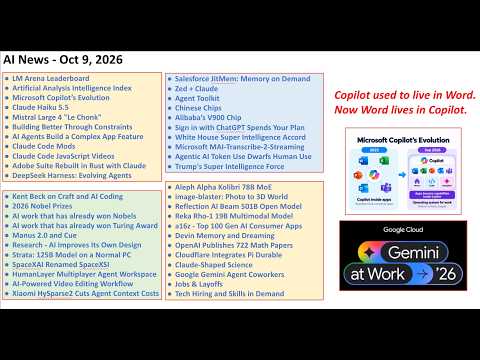
Microsoft's Copilot pivot: Product over models
Microsoft is quietly admitting that raw model intelligence isn't enough to drive adoption. By stripping low-value entry points from Windows and shifting to a multi-model routing strategy, they are prioritizing product form factors over benchmark chasing. This signals a broader industry correction where utility beats novelty, forcing labs to prove their models fit into actual workflows rather than just winning leaderboards.
The Rundown AI
 © Lev Selector
Models & Labsmodels
Mistral Large 4 and Claude Haiku 5.5 Released
Mistral releases Large 4 'Le Chonk' while Anthropic launches Claude Haiku 5.5, continuing the trend of cheaper, faster frontier models.
Lev Selector