Models & Labs
llama.cpp b10828 Release Adds Spark2_5ForCausalLM
llama.cpp Releaseshigh confidence
Why it matters
- →Expands support for causal language models with new implementations.
- →Involves collaboration with Hugging Face, a key player in AI development.
- →Offers broader platform compatibility, enhancing developer flexibility.
The b10828 release of llama.cpp has been announced, featuring support for the Spark2_5ForCausalLM implementation. This update also includes the addition of the Spark3 model, which has been renamed to Spark2_5. Co-authored by contributors from Hugging Face, the release expands the model's capabilities across multiple platforms such as macOS, Linux, and Windows. However, some configurations are still disabled. This update provides developers with enhanced tools for working with causal language models.
Read originalMore from llama.cpp Releases
Open Sourcemodels
llama.cpp b10821 release expands platform support
The b10821 release of llama.cpp marks another step in broadening its platform reach, now featuring ROCm 10.0 support on both Ubuntu and Windows, alongside Vulkan compatibility. This update ensures that developers can utilize llama.cpp's capabilities across a wider array of hardware and operating systems. While it doesn't introduce new model architectures, the release strengthens llama.cpp's utility as a flexible tool for AI inference. Developers now have increased options for deploying AI models locally, making it easier to work with different setups and configurations.
llama.cpp Releases
Open Sourcecoding
llama.cpp b10822 Release Simplifies Cross-Compilation
The b10822 release of llama.cpp marks a notable improvement in the build process by embedding UI assets directly with CMake, which removes the need for a build-time C++ helper and external gzip dependency. This update enhances the readability of generated C++ templates and makes cross-compilation more straightforward. The release supports a broad array of platforms, including macOS, Linux, and Windows, with specific configurations like Vulkan, ROCm, and CUDA. By streamlining these processes, llama.cpp becomes more accessible and easier to deploy, offering developers a more efficient tool for diverse environments.
llama.cpp Releases
Models & Labsmodels
llama.cpp b10823 Release Expands Platform Support
The latest b10823 release of llama.cpp continues to enhance its platform compatibility, now featuring ROCm 10.0 support on both Ubuntu and Windows. This update also brings improved Vulkan support, making it more accessible for developers working with diverse hardware setups. While there are no new model architectures introduced, the release strengthens llama.cpp's role as a flexible tool for AI inference across different environments. Developers can now take advantage of these updates to optimize performance on AMD and NVIDIA GPUs, as well as other architectures, ensuring efficient AI processing.
llama.cpp Releases
More in Models & Labs
 © The AI Daily Brief
Models & Labsmodels
Kimi K3 Triggers Second DeepSeek Moment
Kimi K3 has initiated a significant event known as the second DeepSeek moment.
The AI Daily Brief
 © The AI Advantage
Models & Labsmodels
GPT-6 Astra: Exploring New AI Capabilities
GPT-6 Astra is making a significant impact with its diverse capabilities, as evidenced by a range of real-world applications. The model has been employed to construct a 3D city simulator in just five days and transform Van Gogh paintings into a walkable town, demonstrating its adaptability. It has also been used to automate intricate tasks such as auditing financial models and reconciling budgets, indicating its potential in both creative and practical fields. This release represents a notable advancement in AI's ability to tackle complex tasks, expanding the possibilities of what AI can achieve in real-world scenarios.
The AI Advantage
 © GitHub Changelog
Models & Labscoding
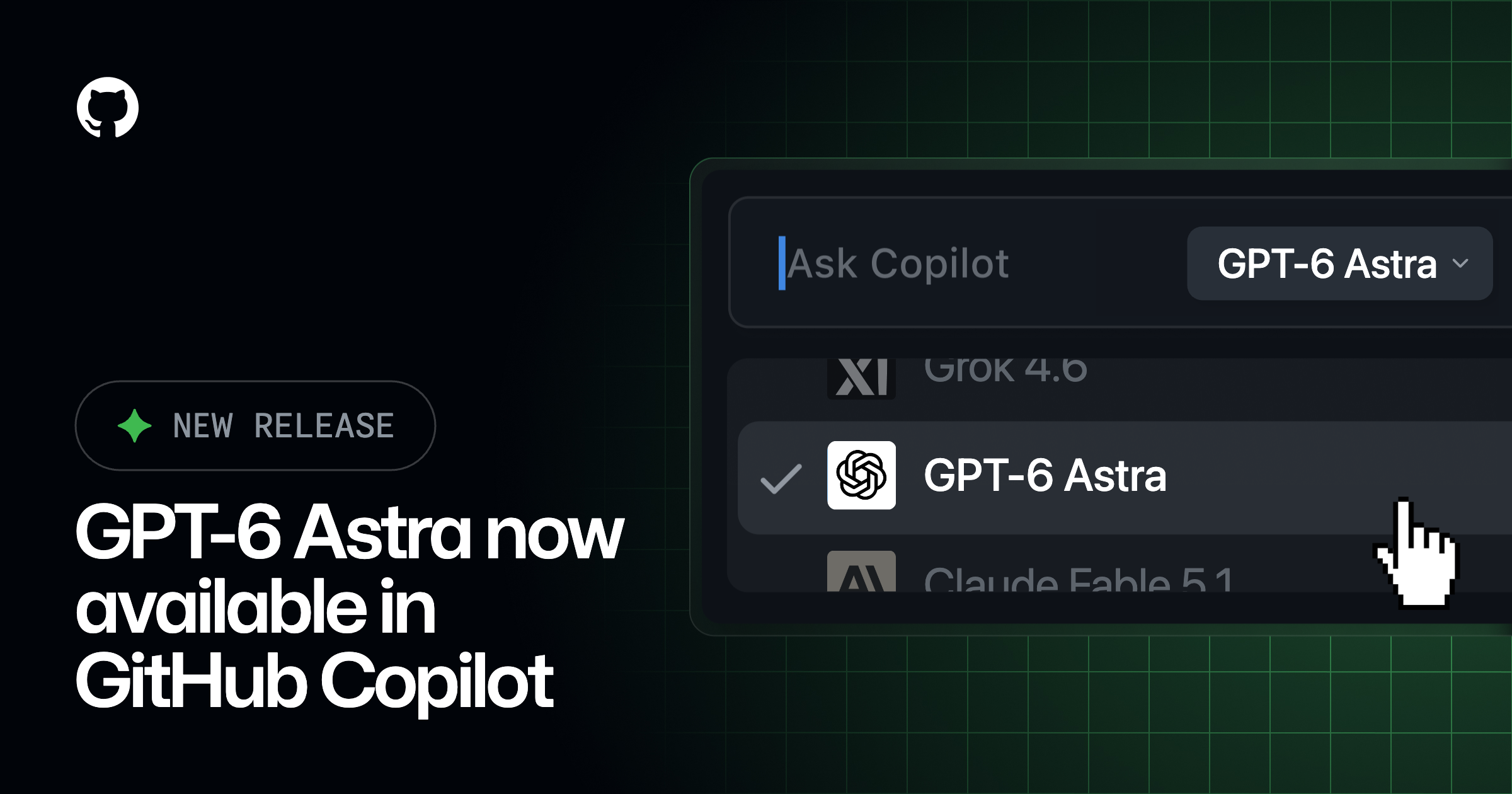
GPT-6 Astra now in GitHub Copilot
OpenAI's GPT-6 Astra is now part of GitHub Copilot, bringing advanced capabilities for complex coding tasks. This model excels in planning and validating its processes, which translates to more efficient coding with fewer steps. Users of Copilot Pro+, Max, Business, and Enterprise can now access GPT-6 Astra through tools like Visual Studio Code and JetBrains IDEs. This integration signifies a major leap in AI-driven coding assistance, enabling developers to tackle more sophisticated tasks with greater ease. The rollout is gradual, ensuring a smooth transition for users adopting this new model.
GitHub Changelog