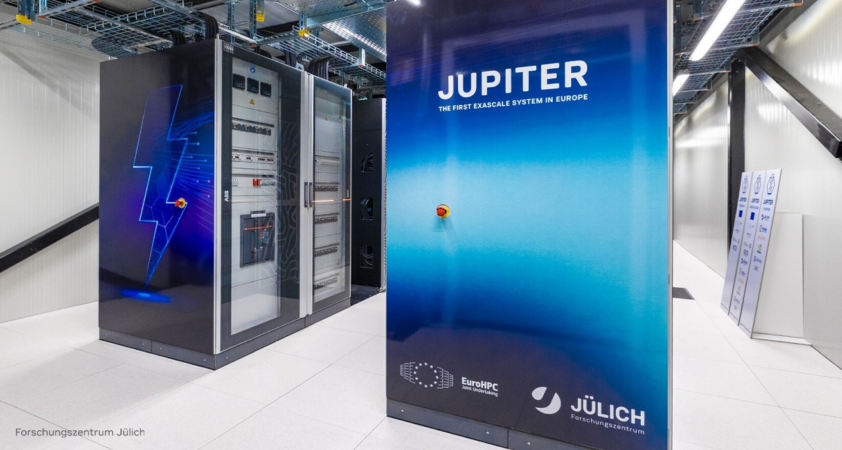
JUPITER, Europe's first exascale supercomputer located at Germany's Forschungszentrum Jülich, is demonstrating the power of exascale computing in various scientific fields. Utilizing NVIDIA Grace Hopper Superchips, JUPITER supports projects such as brain mapping, climate simulation, and quantum computing. These projects illustrate the practical applications of exascale computing, moving beyond theoretical research. JUPITER's capabilities are setting new standards in computational science, enabling more detailed and comprehensive simulations than ever before.
Read original
© NVIDIA BlogNVIDIA and AWS are collaborating to streamline AI deployment at scale, addressing key challenges like low-latency inference and GPU price-performance. The introduction of EC2 G7 instances, powered by NVIDIA RTX PRO 4500 Blackwell GPUs, offers significant performance improvements over previous generations, making them ideal for AI, graphics, and data analytics workloads. Additionally, NVIDIA's cuVS library now powers GPU-accelerated vector indexing in Amazon OpenSearch, drastically reducing costs and time for building large-scale vector databases. This partnership ensures that enterprises can leverage high-performance AI infrastructure without the complexity of managing it themselves.
© NVIDIA BlogNVIDIA's new Agent Toolkit is a significant step towards creating specialized AI agents that can be customized and trusted by enterprises. By providing a modular foundation of models, tools, and secure runtime, the toolkit allows businesses to build AI systems tailored to their specific workflows. This development is particularly impactful in industries like life sciences and healthcare, where AI agents can drastically reduce the time needed for complex tasks such as protein design and clinical documentation. The toolkit's open nature ensures that companies can integrate these agents into existing systems, enhancing efficiency and control.
© NVIDIA BlogNVIDIA's technology now powers over 400 of the world's 500 fastest supercomputers, marking a significant presence in the TOP500 list. This dominance is driven by their GPUs and networking solutions, with NVIDIA Grace CPUs seeing increased adoption. The company's systems are not only fast but also energy-efficient, as evidenced by their top rankings in the Green500 list. This trend highlights the growing reliance on accelerated computing for AI and scientific research, with NVIDIA at the forefront of this shift. The landscape of high-performance computing is increasingly defined by NVIDIA's comprehensive hardware stack.
GPT-5 Pro has made a notable impact in the field of immunology by resolving a complex issue related to T cell behavior that had puzzled researchers for three years. This achievement opens new avenues for cancer and autoimmune disease research, demonstrating AI's potential to contribute to scientific breakthroughs. By offering innovative data analysis and insights, GPT-5 Pro proves its value beyond conventional applications, potentially speeding up medical discoveries. This development signifies a shift in how AI can be utilized to tackle intricate biological challenges, setting the stage for future advancements in healthcare.
© MIT News AIMIT researchers have developed a groundbreaking chip that enables tiny robots to create detailed 3D maps of their environments using minimal power. This innovation combines an efficient mapping algorithm with specialized hardware, allowing the chip to consume only about 6 milliwatts of power. By using Gaussians instead of traditional voxels, the chip can represent obstacles more compactly, significantly reducing memory and power requirements. This advancement could revolutionize applications in autonomous drones and augmented reality, offering real-time mapping capabilities with minimal energy consumption.
© Together AI BlogParallelKernelBench (PKB) has uncovered the challenges faced by large language models (LLMs) in generating efficient multi-GPU kernels. While LLMs have shown promise in single-GPU scenarios, models like GPT-5.5 and Gemini 3 Pro are struggling with multi-GPU tasks, solving less than a third of the benchmark problems accurately. The core difficulty lies in managing complex communication patterns and rank coordination, which are vital for multi-GPU performance. Although there are instances where models produce high-performance kernels for specific applications, the overall results indicate a significant gap in current AI capabilities for optimizing distributed workloads. This suggests that further advancements are needed to enhance AI-driven optimization in multi-GPU environments.