Models & Labs
Claude 4.6 and New Model Releases Announced
Lev Selectorhigh confidence
Why it matters
- →The introduction of these models signifies continuous improvement in AI capabilities, offering more options for developers.
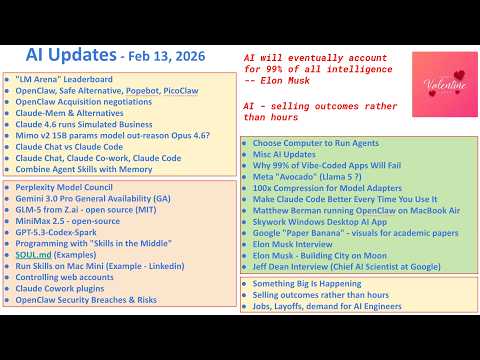
Claude 4.6 has been released, showcasing its capabilities in simulated business environments. Alongside this, new models such as Mimo v2 with 15 billion parameters, MiniMax 2.5, GLM-5 from Z.ai, and GPT-5.3-Codex-Spark have also been introduced. These advancements reflect the ongoing evolution of AI models, enhancing their reasoning and operational capabilities. The release of these models is expected to provide developers with more powerful tools for various applications.
Read originalThe story around this
Earlier coverage that leads up to this article, and what followed. Lines connect each piece to the closest one after it, converging here.
More from Lev Selector
 © Lev Selector
Market & Regulationbusiness
OpenAI Eyes $1.5 Trillion Valuation
Reports indicate OpenAI is targeting a valuation of $1.5 trillion in its next funding round, reflecting massive investor confidence.
Lev Selector
© Lev SelectorMarket & Regulationbusiness
Cohere and Aleph Alpha Announce $20B Merger
More in Models & Labs
Models & Labsother
llama.cpp b11193 adds Snapdragon Hexagon and ROCm 10
This release quietly expands llama.cpp's hardware support to include Qualcomm's Hexagon NPU on Linux arm64, a significant step for local inference on Snapdragon devices. It also updates CUDA builds to version 13.4 and introduces ROCm 10.0 binaries, keeping the project aligned with the latest NVIDIA and AMD driver ecosystems. KleidiAI on Apple Silicon is temporarily disabled in this build, likely due to stability checks rather than a feature rollback. For developers targeting edge AI or diverse GPU stacks, this update ensures broader compatibility without requiring custom compilation.
llama.cpp Releases
 © TechCrunch AI
Models & Labsresearch
