Models & Labs
llama.cpp b10085 release updates Qwen3-VL interpolation
llama.cpp Releaseshigh confidence
Why it matters
- →Aligns interpolation method with transformers reference for accuracy.
- →Reduces discrepancies in image scaling, crucial for AI tasks.
- →Enhances reliability of llama.cpp for developers.
The b10085 release of llama.cpp focuses on improving the Qwen3-VL vision model's position embedding interpolation. The update aligns the interpolation method with the transformers reference, using align_corners=True, which corrects scaling issues for grounding coordinates in images. This adjustment is particularly important for larger and non-square images, ensuring more accurate image processing. The release does not introduce new models but enhances the precision of existing features, making it a valuable update for developers.
Read originalMore from llama.cpp Releases
Models & Labsmodels
llama.cpp b10083 Release Expands Platform Support
The latest b10083 release of llama.cpp continues its trend of broadening platform compatibility, making it a versatile choice for developers across different systems. Notably, this update includes support for Ubuntu with ROCm 7.2, enhancing performance for AMD GPU users. Windows users benefit from updated CUDA support, with DLLs for both CUDA 12.4 and 13.3, ensuring compatibility with the latest NVIDIA technologies. While no groundbreaking new features are introduced, the release solidifies llama.cpp's position as a flexible inference runtime across diverse hardware setups.
llama.cpp Releases
Open Sourcemodels
llama.cpp b10084 Release Expands Platform Support
The latest b10084 release of llama.cpp continues its trend of broadening platform compatibility, making it a versatile tool for developers across various systems. Notably, this update includes support for Ubuntu with ROCm 7.2, enhancing performance for AMD GPU users, and expands Vulkan support across multiple operating systems. While KleidiAI support for macOS Apple Silicon is disabled, the release still offers a comprehensive range of builds for Windows, Linux, and openEuler. This update solidifies llama.cpp's position as a go-to runtime for diverse hardware configurations, though it doesn't introduce new model architectures.
llama.cpp Releases
Open Sourcemodels
llama.cpp b10087 Release Expands Platform Support
The b10087 release of llama.cpp marks a significant step in broadening its hardware compatibility, with ROCm 7.2 now available for Ubuntu x64, offering AMD GPU users a more competitive alternative to NVIDIA's CUDA. This update also introduces Vulkan support, enhancing the software's adaptability across different operating systems. While the release doesn't bring new model architectures, the focus remains on making llama.cpp a versatile tool for developers. By expanding support for various hardware configurations, llama.cpp continues to position itself as a go-to solution for diverse development environments.
llama.cpp Releases
More in Models & Labs
 © NVIDIA Blog
Models & Labsmodels
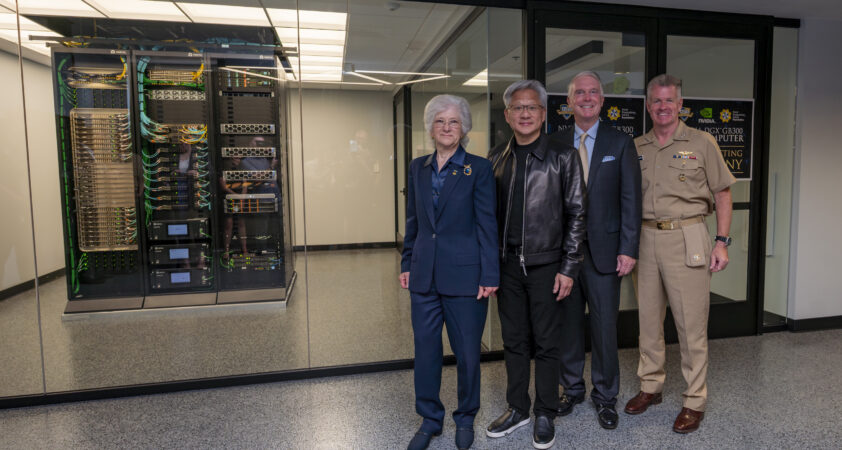
NVIDIA AI Supercomputer Deployed at Naval School
NVIDIA has commissioned its DGX GB300 supercomputer at the Naval Postgraduate School, marking a significant step in integrating advanced AI capabilities into military education. This powerful AI platform will enable students and faculty to engage in large-scale AI computing, enhancing research in areas like weather prediction and cybersecurity. The collaboration aims to modernize military education by providing hands-on experience with cutting-edge AI tools. This deployment not only enriches academic programs but also prepares military leaders to leverage AI in real-world scenarios.
NVIDIA Blog
 © WIRED AI
Models & Labsmodels
Chinese AI Models Challenge Silicon Valley's Dominance
Chinese AI labs are making significant strides with open-source models that are beginning to rival the best from Silicon Valley. Moonshot AI's Kimi K3 model, in particular, has drawn attention for its impressive performance in web development and agentic tasks, challenging the belief that only closed-source models can achieve top-tier results. This development marks a growing divergence in strategy between Chinese and American AI companies, with the former embracing openness to attract users and collaborators. As these models gain traction, they are prompting a reevaluation of the value of paying for Western alternatives, suggesting a potential shift in the AI landscape.
WIRED AI
 © Fireship
Models & Labsmodels
Moonshot releases Kimi K3 with 2.8 trillion parameters
Moonshot has unveiled Kimi K3, an open-weight AI model boasting an impressive 2.8 trillion parameters. This release marks a significant leap in the scale of AI models, potentially offering enhanced capabilities in processing and understanding complex data. While the sheer size of Kimi K3 is noteworthy, the real test will be in its practical applications and performance compared to existing models. This development could pave the way for more advanced AI systems, but its true impact will depend on how effectively it can be utilized in real-world scenarios.
Fireship