16 × AIAI signal, amplified
AI newsAboutSources
TelegramFollow on Telegram
AI newsAboutSources
16 × AIAI signal, amplified

An AI news engine that ingests trusted sources, scores with Claude, and posts only what clears the bar.

Follow on Telegram →

Subscribe

  • Telegram
  • RSS
  • All channels

Legal

  • Privacy
  • Imprint
© 2026 16 × AI. All rights reserved.Curated by Claude. Posts every 6 hours. No newsletter, no funnel.
Home/Models & Labs
Models & Labs

Kimi K2.7 Code Now Available in GitHub Copilot

GitHub Changelog·July 1, 2026·high confidence

Why it matters

  • →Provides developers with more choice in selecting AI models for coding workflows.
  • →Offers a potentially lower-cost option compared to existing models.
  • →Expands the flexibility and accessibility of GitHub Copilot for various user plans.
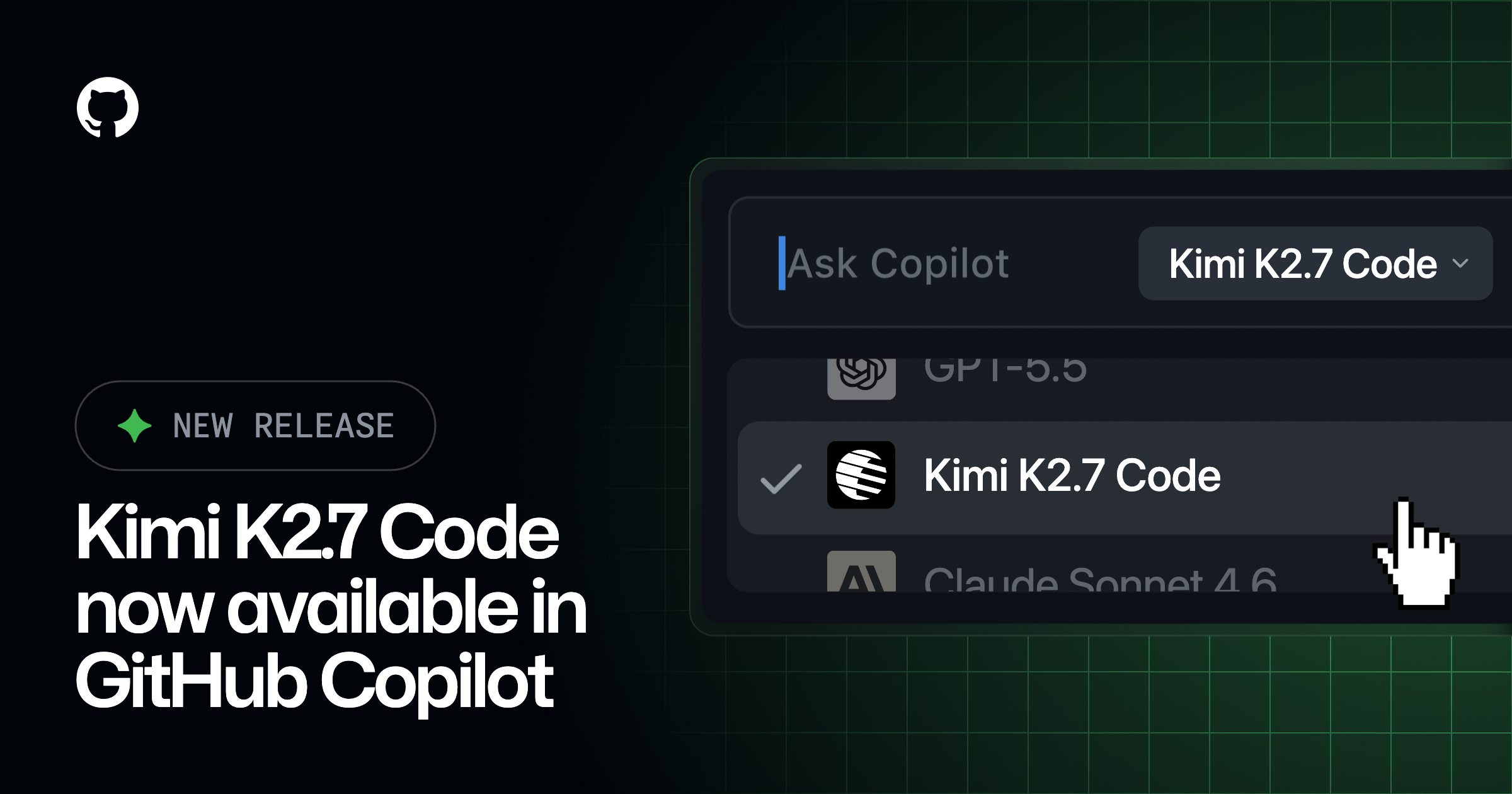
Kimi K2.7 Code Now Available in GitHub Copilot
©GitHub Changelog

GitHub has made the Kimi K2.7 Code model generally available in GitHub Copilot, marking the first open-weight model option in the platform's model picker. Hosted on Microsoft Azure, this model is available under usage-based billing and is initially rolling out to Copilot Pro, Pro+, and Max plans. Users can select the model in Visual Studio Code and other platforms, with plans to expand to Copilot Business and Enterprise. This development offers developers more choice and potentially lower costs in their coding workflows.

Read original

More from GitHub Changelog

CodeQL 2.26.0 Enhances Security with AI Detection© GitHub Changelog
Coding Toolscoding

CodeQL 2.26.0 Enhances Security with AI Detection

CodeQL 2.26.0 marks a significant step forward for GitHub's static analysis engine, particularly in addressing security vulnerabilities. This release expands its capabilities to include Kotlin 2.4.0, while also adding a crucial query for identifying AI prompt injection risks in JavaScript and TypeScript. By refining existing queries and introducing new ones across languages like C#, Go, and Python, the update reduces false positives and enhances detection accuracy. These improvements make CodeQL a more powerful tool for developers focused on securing their code, especially in AI-driven contexts. The update is automatically available to GitHub code scanning users, ensuring immediate benefits for those on the platform.

GitHub Changelog·Jul 10, 2026
GitHub REST API Enhances Multi-User Budget Tracking© GitHub Changelog
Coding Toolscoding

GitHub REST API Enhances Multi-User Budget Tracking

GitHub has streamlined budget management for enterprises by introducing a REST API endpoint that allows for efficient tracking of individual user consumption against multi-user budgets. Previously, checking each user's budget usage required separate API calls, making the process cumbersome for large organizations. Now, enterprise owners and billing managers can quickly identify users nearing their budget limits, thanks to new filtering and sorting capabilities. This update simplifies financial oversight and reduces the need for custom scripts, making budget management more accessible and efficient.

GitHub Changelog·Jul 10, 2026
GitHub Launches New Pull Requests Dashboard© GitHub Changelog
Coding Toolscoding

GitHub Launches New Pull Requests Dashboard

GitHub has officially launched its new pull requests dashboard, providing a centralized hub for developers to manage and prioritize their pull requests. This feature, previously in public preview, now offers enhanced filtering and search capabilities, allowing users to create custom views and utilize advanced search queries. The dashboard aims to streamline the workflow for both individual contributors and managers by surfacing critical pull requests that require attention. This update marks a significant improvement in how developers can interact with and manage their contributions across multiple projects.

GitHub Changelog·Jul 9, 2026

More in Models & Labs

Models & Labsmodels

Llama.cpp b9946 Release Enhances Hexagon Optimizations

The latest b9946 release of llama.cpp focuses on optimizing Hexagon operations, particularly unary operations, to improve performance and efficiency. By introducing tiling for wide rows and replacing divisions with fastdiv, the update aims to prevent VTCM overflow and streamline code execution. The release also includes tracing instrumentation and specialized thread functions to enhance code generation. While no new models are introduced, these technical improvements make llama.cpp more robust and efficient for developers working with Hexagon architectures.

llama.cpp Releases·Jul 11, 2026
Models & Labsmodels

Llama.cpp b9948 Release Enhances CUDA Efficiency

The latest b9948 release of llama.cpp focuses on optimizing memory usage in CUDA operations, specifically in the ggml_top_k() and ggml_argsort() functions. By processing data in smaller chunks, the update reduces the need for large temporary buffers, enhancing performance on CUDA-enabled systems. This release also includes minor code improvements like allocating temporary destinations only once and refining the use of ternary operators. While no new model architectures are introduced, these changes make llama.cpp more efficient for developers working with CUDA, particularly in memory-constrained environments.

llama.cpp Releases·Jul 11, 2026
Models & Labsmodels

llama.cpp b9951 Release Enhances ET Backend

The latest b9951 release of llama.cpp marks a significant enhancement in the ET backend, introducing a range of new kernels and performance optimizations. This update includes the addition of various matrix operations and support for FlashAttention, which promises to improve computational efficiency. The release also focuses on vectorization and parallelization, aiming to boost performance across different operations. These changes make the ET backend more robust and capable, potentially benefiting developers working with complex AI models by offering improved speed and functionality.

llama.cpp Releases·Jul 11, 2026