Market & Regulation
Q2 Sees Record Billion-Dollar Startup Exits
Crunchbase Newshigh confidence
Why it matters
- →SpaceX's IPO set a new benchmark for venture-backed exits.
- →The trend towards larger exits could reshape the startup landscape.
- →Upcoming IPOs from major AI companies could further test market limits.
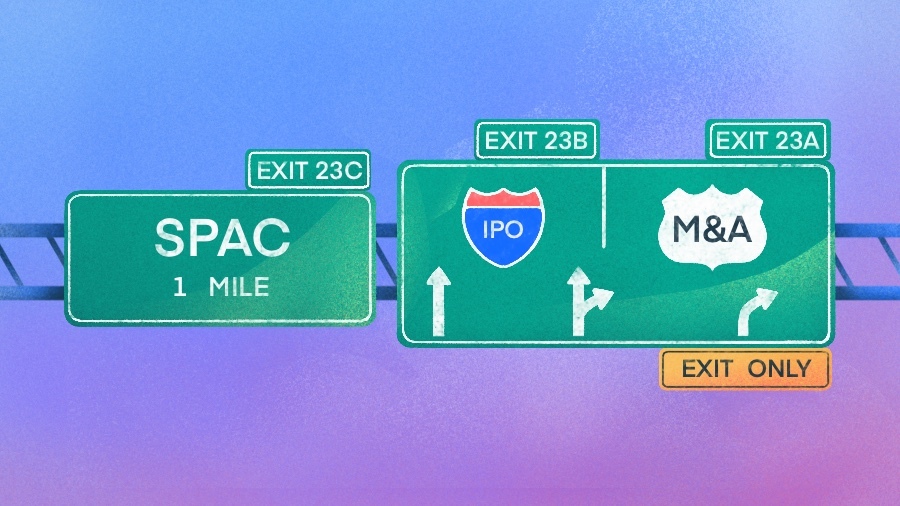
In Q2 2026, billion-dollar startup exits reached their highest level since 2021, driven by SpaceX's record-breaking IPO. SpaceX achieved a $2.1 trillion market cap and raised $75 billion, marking the largest venture-backed exit ever. The company also acquired AI coding platform Cursor for $60 billion, setting a record for private startup purchases. Despite fewer exits compared to past peaks, the size of these deals is significant, suggesting a trend towards larger but fewer exits. This trend may persist with potential IPOs from Anthropic and OpenAI.
Read originalThe story around this
Earlier coverage that leads up to this article, and what followed. Lines connect each piece to the closest one after it, converging here.
More from Crunchbase News

More in Market & Regulation
 © TechCrunch AI
Market & Regulationbusiness
Crusoe cancels $1.25B Boom turbine deal
The collapse of Crusoe’s $1.25 billion order for Boom Supersonic’s stationary turbines exposes the fragility of AI infrastructure financing. While Crusoe raised $3.9 billion, it pivoted away from on-site gas generation, opting instead for grid power and diverse energy mixes. This signals that even well-funded data center operators are prioritizing flexibility over massive, long-term capital commitments to specialized hardware. Boom’s pivot to sell jet engines as power plants was a bold bet on AI energy needs, but losing its anchor customer suggests the market is more cautious than anticipated.
TechCrunch AI
 © TechCrunch AI