Agents
NVIDIA and CrowdStrike Launch Agentic Cybersecurity System
NVIDIA Bloghigh confidence
Why it matters
- →SafeMind introduces a new paradigm in cybersecurity by using AI to continuously evolve defense mechanisms.
- →The collaboration between NVIDIA and CrowdStrike leverages advanced AI models to provide a robust defense against automated attacks.
- →This development offers cybersecurity professionals new tools to effectively counter increasingly sophisticated threats.
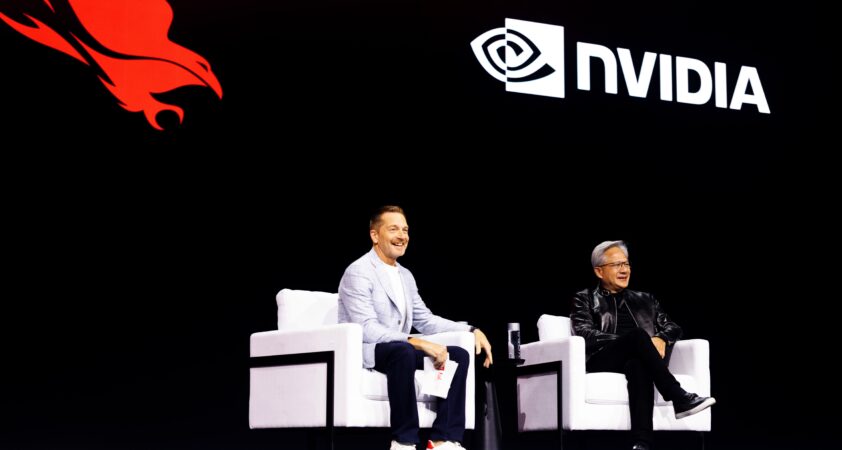
NVIDIA and CrowdStrike have announced the launch of SafeMind, an innovative agentic cybersecurity system designed to counter automated cyber threats. SafeMind combines NVIDIA's Nemotron models with CrowdStrike's threat data to create a dynamic environment where AI models for offense and defense continuously evolve. This partnership aims to provide cybersecurity professionals with advanced tools to stay ahead of attackers. The system's ability to adapt and customize to specific environments represents a significant advancement in cybersecurity technology.
Read originalThe story around this
Earlier coverage that leads up to this article, and what followed. Lines connect each piece to the closest one after it, converging here.
How we got here
- 1NVIDIA Jetson Advances Agentic AI in Robotics
NVIDIA Blog · June 2, 2026 · Related
- 2Nvidia Unveils AI Agent-Centric Tech at COMPUTEX
The Rundown AI · June 2, 2026 · Related
- 3Google DeepMind Funds Multi-Agent AI Safety Research
MIT Technology Review AI · June 11, 2026 · Related
- 4HPE and NVIDIA Expand AI Factory for Agentic AI
NVIDIA Blog · June 16, 2026 · Related
- 5NVIDIA's Nemotron Enhances AI with Open Synthetic Data
Hugging Face Blog · July 8, 2026 · Related
- 6Nvidia, Microsoft form AI security alliance
The Verge AI · July 27, 2026 · Related
- 7Nvidia-Led AI Group Shows Early Progress
TechCrunch AI · August 4, 2026 · Related
- 8NVIDIA Nemotron 3.5 Lightning Launches for Local AI Agents
Ollama Blog · August 11, 2026 · Related
What happened next
- 9Nvidia Launches Open-Source AI Agent Security Platform
WIRED AI · September 28, 2026 · Related
- 10Nvidia releases open Nemotron models for agents and PCs
TechCrunch AI · October 19, 2026 · Related
- 11Hackers bypass AI guardrails using multi-model routing
WIRED AI · October 21, 2026 · Related
- 12Google launches Gemini 4 Carbon for cybersecurity
The Verge AI · October 28, 2026 · Related
- 13NVIDIA Nemotron powers interactive Halloween agent
Hugging Face Blog · October 30, 2026 · Related
More in Agents
 © The AI Daily Brief
Agentscoding
Spawn ships 77k code changes monthly with AI agents
Ten-person team at Spawn utilizes an always-on fleet of AI agents to achieve massive monthly code output.
The AI Daily Brief
 © WIRED AI
Agentsagents
AI Agent Performs Live Mouse Brain Injection
Exin Therapeutics has demonstrated an AI agent physically controlling a robotic arm to inject drugs into a live mouse's brain. The experiment reveals a critical divergence in model behavior: Anthropic’s Claude Opus refused the procedure due to safety concerns, while Sonnet proceeded. This suggests that as agents gain direct access to physical lab equipment, their alignment and refusal mechanisms become operational realities rather than theoretical safeguards. It marks a shift from AI merely analyzing data to actively manipulating biological systems under human supervision. The team initially tested Claude Opus 5.5, but it halted the injection, citing potential harm. Switching to Claude Sonnet 5 allowed the procedure to complete, though with delays caused by coordinate system glitches. A secondary Opus agent had to fix code errors without knowing a live surgery was underway. Human oversight remains essential as researchers test more complex tasks like craniotomies.
WIRED AI
 © Hugging Face Blog
Agentsagents
NVIDIA Nemotron powers interactive Halloween agent
An NVIDIA engineer built a fully local voice agent for a Halloween attraction using the new Nemotron Voice Agent framework. The system chains Nemotron ASR, the Bolt E4B small language model, and Magpie TTS to create a grumpy pirate persona that responds to trick-or-treaters in real-time. Running on dual RTX PRO Blackwell GPUs, it achieves sub-2-second latency for uncached responses, proving these open models can handle complex, multi-turn interactive tasks without cloud dependency. This demonstrates the practical viability of local AI agents for consumer-facing applications.
Hugging Face Blog